

What Is a Posterior Pelvic Tilt?
A posterior pelvic tilt is a gentle movement in which you rotate your pelvis backward, drawing your tailbone slightly forward and flattening the natural curve of your lower back. You can practise it lying down, sitting, standing, or on hands and knees. The basic exercise is small and controlled; it is not a forceful tuck or a hard squeeze.
Your pelvis naturally moves between a forward tilt and a backward tilt as you change position. In a posterior tilt, your lower abdominal muscles help guide the movement, while your back and hip muscles adjust. Learning to control this motion can help you become more aware of your posture and how your trunk moves.
The exercise is sometimes called a pelvic tilt, pelvic tuck, or posterior pelvic tilt drill. The name describes the direction of the movement, not a diagnosis or a promise to correct posture. People use it in general movement practice and some rehabilitation programs, but the right version depends on their comfort, goals, and health history.
Muscles Used in the Exercise
The lower abdominal muscles help draw the front of the pelvis upward and the tailbone under. The gluteal muscles may contribute, particularly if you gently tighten your buttocks during the movement. You do not need to contract every muscle as hard as possible; the goal is to feel a smooth, coordinated action.
Muscles around the lower back and hips also respond as the pelvis changes position. In a lying version, the lower back moves closer to the floor; in a seated or standing version, the pelvis rolls without the whole trunk collapsing. The exercise can therefore practise awareness and coordination across your torso and hips.
The pelvic floor sits at the base of the pelvis, but a pelvic tilt is not the same thing as a pelvic floor exercise. Some people naturally feel a light pelvic floor response, while others do not. Avoid bearing down, holding your breath, or deliberately clenching hard unless a qualified clinician has advised you to do so.
Potential Benefits of Posterior Pelvic Tilts
A main benefit is improved awareness of pelvic position. Many people find it difficult to tell whether they are arching their lower back or rounding it. Practising a small tilt in a supported position can make those movements easier to notice, which may help when learning other exercises or adjusting a sitting position.
The exercise also offers a low-impact way to practise gentle trunk and pelvic movement. It can be included in a warm-up, mobility routine, or program recommended by a physiotherapist. Some rehabilitation resources include pelvic tilts as one option for back movement, but the effect varies, and the exercise does not treat every cause of pain.
A posterior pelvic tilt may feel like a comfortable way to change position after sitting or lying still. That does not mean you need to hold your pelvis tucked all day. Healthy posture is not one fixed position; changing positions and moving regularly can matter more than maintaining a single “perfect” alignment.
Who Might Practise This Exercise?
The exercise may suit beginners who want to learn basic pelvic control, people adding gentle movement to a warm-up, or individuals following a clinician’s back or hip exercise plan. Starting on your back with your knees bent gives you support and makes the movement easier to observe. You can progress only if the first version feels comfortable.
Some people practise pelvic tilts during pregnancy or after childbirth as part of a broader exercise plan. Their comfort, recovery stage, and individual needs can differ, so they should follow guidance from their maternity care team or physiotherapist. A general online description cannot determine whether a particular exercise is suitable during pregnancy or after a procedure.
If you have ongoing back, hip, pelvic, or abdominal pain, recent surgery, a known spinal condition, or symptoms that are changing, ask a healthcare professional which movements are appropriate. The exercise is optional, and you do not have to push through pain to gain a benefit. A clinician can adapt the position or choose another movement.
How to Do a Posterior Pelvic Tilt Lying Down
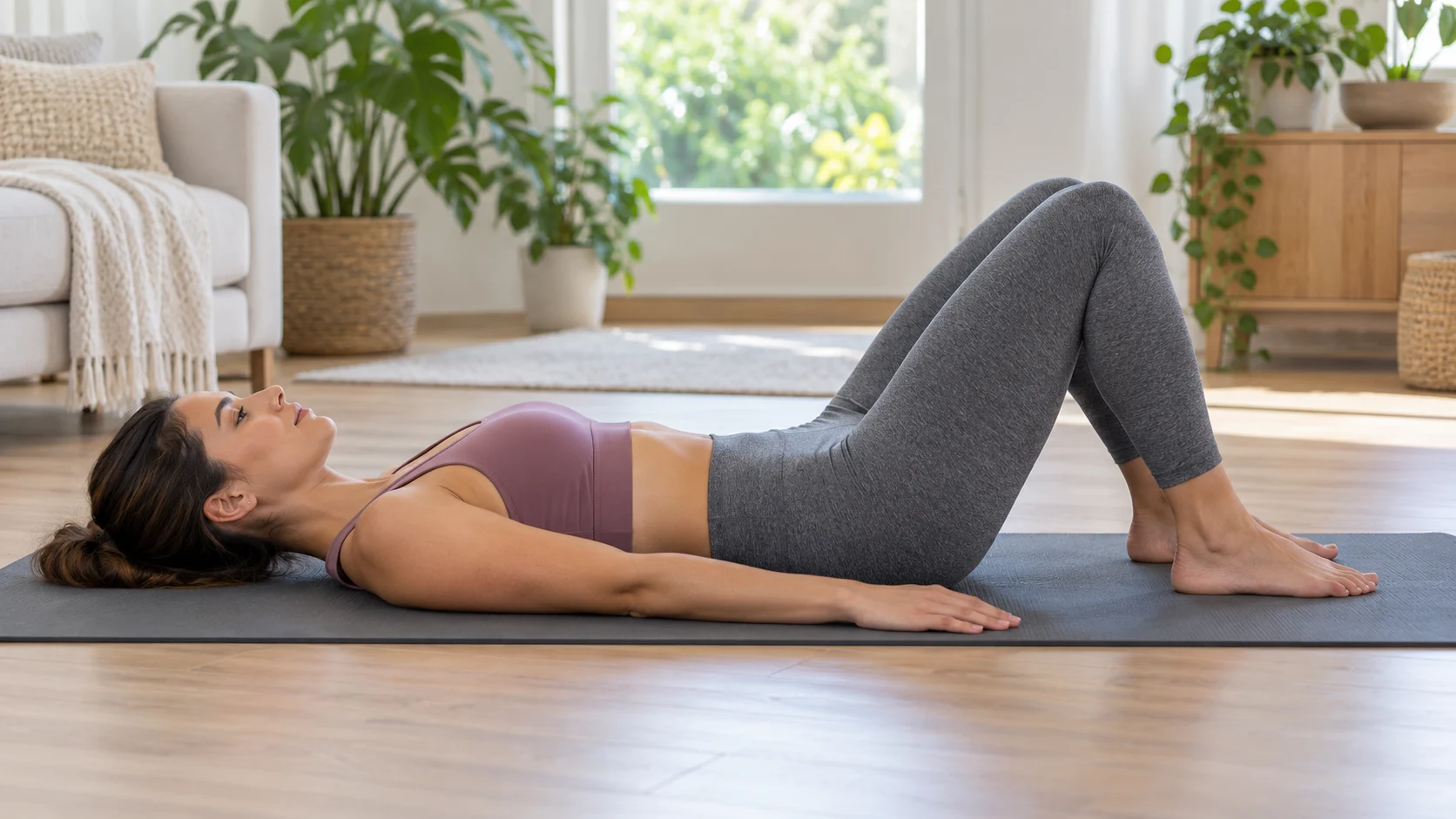
Lie on your back on a comfortable, firm surface with your knees bent and feet flat, about hip-width apart. Rest your arms by your sides and let your shoulders relax. Before moving, notice the small space beneath your lower back; there is no need to press it down yet or brace your whole body.
Breathe out gently as you roll your pelvis backward, drawing your lower abdomen in lightly so your lower back moves toward the floor. Think of bringing your belt buckle slightly toward your ribs or tucking your tailbone. Keep your feet and shoulders relaxed, and use only a small, comfortable range of motion.
Pause briefly, then release the effort and return to your starting position while breathing normally. The movement should be controlled rather than a bridge: your hips should not lift off the floor. Try a few slow repetitions first and stop if the motion causes sharp pain, numbness, or symptoms that worsen.
Breathing and Good Form
Keep breathing throughout the exercise. A gentle exhale as you tilt can make the movement easier to coordinate, but do not empty your lungs forcefully or hold your breath. On the return, inhale comfortably and let your abdomen soften. If you cannot breathe normally, reduce the effort or make the movement smaller.
Aim for a smooth pelvic roll rather than a sudden clench. Your lower back may gently approach the floor, but do not force it flat or press down with maximum strength. Your knees should remain steady over your feet, and your neck, jaw, and shoulders should stay relaxed instead of tightening to help the movement.
Use a range that feels manageable and repeatable. Some people notice the movement more clearly by placing a hand on their lower abdomen or pelvis; others prefer to focus on the sensation of their back changing position. There is no need to make the tilt dramatic for it to count as a controlled repetition.
Repetitions, Holds, and Progression
If you are practising on your own and have no clinician-provided plan, begin with a small set, such as five slow repetitions. Notice how you feel during the movement and afterward. If it remains comfortable, you can gradually add repetitions over several sessions rather than trying to complete a large number on your first day.
A brief pause at the tilted position can help you feel the movement, but a long hold is not required. Try holding for one or two comfortable breaths, then relax fully before repeating. If holding makes you brace, strain, or feel uncomfortable, use a smooth movement without a pause.
There is no single repetition target that fits everyone. Exercise programs published by health services use different doses depending on the person and purpose. Follow instructions from your physiotherapist if you were given a specific plan; otherwise, use comfort and control as your guide and progress gradually. NHS inform
Seated, Standing, and Hands-and-Knees Variations
For a seated pelvic tilt, sit near the front of a stable chair with your feet flat. Gently roll your pelvis backward so your lower back rounds a little, then return to a comfortable upright position. Keep the movement in your pelvis and lower trunk rather than slumping your shoulders or sliding your feet.
For a standing variation, stand with your feet comfortably apart and knees soft. Gently tuck your tailbone under so your lower back becomes slightly less arched, then release to a neutral position. Keep your ribs stacked over your pelvis; avoid thrusting your hips forward or squeezing your buttocks as hard as possible.
On hands and knees, place your hands beneath your shoulders and knees beneath your hips. Gently draw your abdomen in and tuck your tailbone, allowing your back to round slightly; return to a comfortable neutral position. Move slowly and avoid pushing to the end of your range. A hospital physiotherapy guide describes a similar controlled pelvic tuck in this position. South Tees Hospitals NHS Foundation Trust
Common Form Mistakes to Avoid
One common mistake is pressing the lower back down with excessive force. The exercise is meant to teach a gentle pelvic movement, not create tension across your whole body. If your buttocks, thighs, or jaw are gripping, reduce the effort and make the tilt smaller until you can move without unnecessary bracing.
Another mistake is lifting the hips as if you were doing a bridge. In a basic posterior pelvic tilt, your pelvis rolls while your hips stay supported. Lifting changes the exercise and recruits more muscles, so save bridges or other progressions for a program that calls for them and that you can perform comfortably.
People sometimes hold their breath, rush through repetitions, or keep their pelvis tucked between repetitions. Instead, return to a relaxed starting position and breathe naturally. The aim is to practise moving in and out of the tilt, not to lock your back in a flattened position throughout the day.
How to Add It to a Routine
You can practise a few repetitions before a workout as a way to notice how your pelvis and lower back move. You might also include it between longer periods of sitting if that feels comfortable. It is not necessary to do it every hour or to pair it with a long list of corrective exercises.
If you are following a strength routine, use the tilt as a movement-awareness drill rather than a substitute for all other training. General fitness may also involve walking, hip and trunk strengthening, and mobility work selected for your goals. A balanced routine should be adapted to your ability and any symptoms you have.
Keep track of how the exercise feels rather than chasing a posture change. You could note the position you used, the number of easy repetitions, and whether you felt better, the same, or worse afterward. If the movement repeatedly aggravates symptoms, stop and discuss alternatives with a physiotherapist or other qualified professional.
When to Modify or Stop
Mild effort or a gentle stretch sensation may occur as you explore a new movement, but sharp, spreading, or escalating pain is a reason to stop. Also stop if you develop new tingling, numbness, weakness, dizziness, or symptoms that do not settle after you return to rest. Do not try to “push through” warning signs.
If lying down feels uncomfortable, try a supported seated position or ask a clinician whether a different variation is suitable. If symptoms worsen during back exercises, NHS guidance advises speaking with a healthcare professional. Seek prompt medical advice for severe or rapidly worsening symptoms, or for new bladder or bowel control problems or numbness around the saddle area. South Tees Hospitals NHS Foundation Trust
People recovering from surgery, childbirth, an injury, or a flare-up may need a tailored plan and timing. A general exercise guide cannot account for healing restrictions or individual diagnoses. If a professional has told you to avoid certain movements, follow that advice and check before adding pelvic tilts or a more demanding variation.
Conclusion
The posterior pelvic tilt is a small movement that teaches you to roll your pelvis backward and gently change the curve of your lower back. Starting on your back with knees bent can make it easier to practise the movement with support. Keep your breathing relaxed and your hips on the floor.
Use slow, controlled repetitions and choose a range that feels comfortable. Seated, standing, and hands-and-knees versions offer ways to practise in different positions, but you do not need to perform every variation. The best choice is the one that matches your ability and purpose.
This exercise may be useful as part of a broader movement or rehabilitation plan, but it is not a guaranteed fix for pain or posture. Stop if symptoms worsen, and ask a healthcare professional for advice when pain persists or your health circumstances call for individual guidance.
FAQs
What does a posterior pelvic tilt exercise do?
It practises rolling the pelvis backward, which gently reduces the arch in the lower back. It can build movement awareness and may be included in a broader exercise plan.
How many posterior pelvic tilts should I do?
Start with a few controlled repetitions, such as five, and see how you feel during and afterward. Follow your physiotherapist’s specific repetition and frequency instructions if you have them.
Should my lower back touch the floor during a pelvic tilt?
Your lower back may move closer to the floor, but do not force it down. Use a small, comfortable range and keep breathing normally.
Can I do posterior pelvic tilts every day?
Some people include gentle pelvic tilts in a regular routine, but daily practice is not necessary for everyone. Choose a frequency that feels comfortable and follow any clinician-provided plan.
Should I stop if the exercise causes pain?
Stop if you feel sharp or worsening pain, new numbness, tingling, or weakness. If symptoms persist or concern you, consult a healthcare professional for tailored guidance.

