

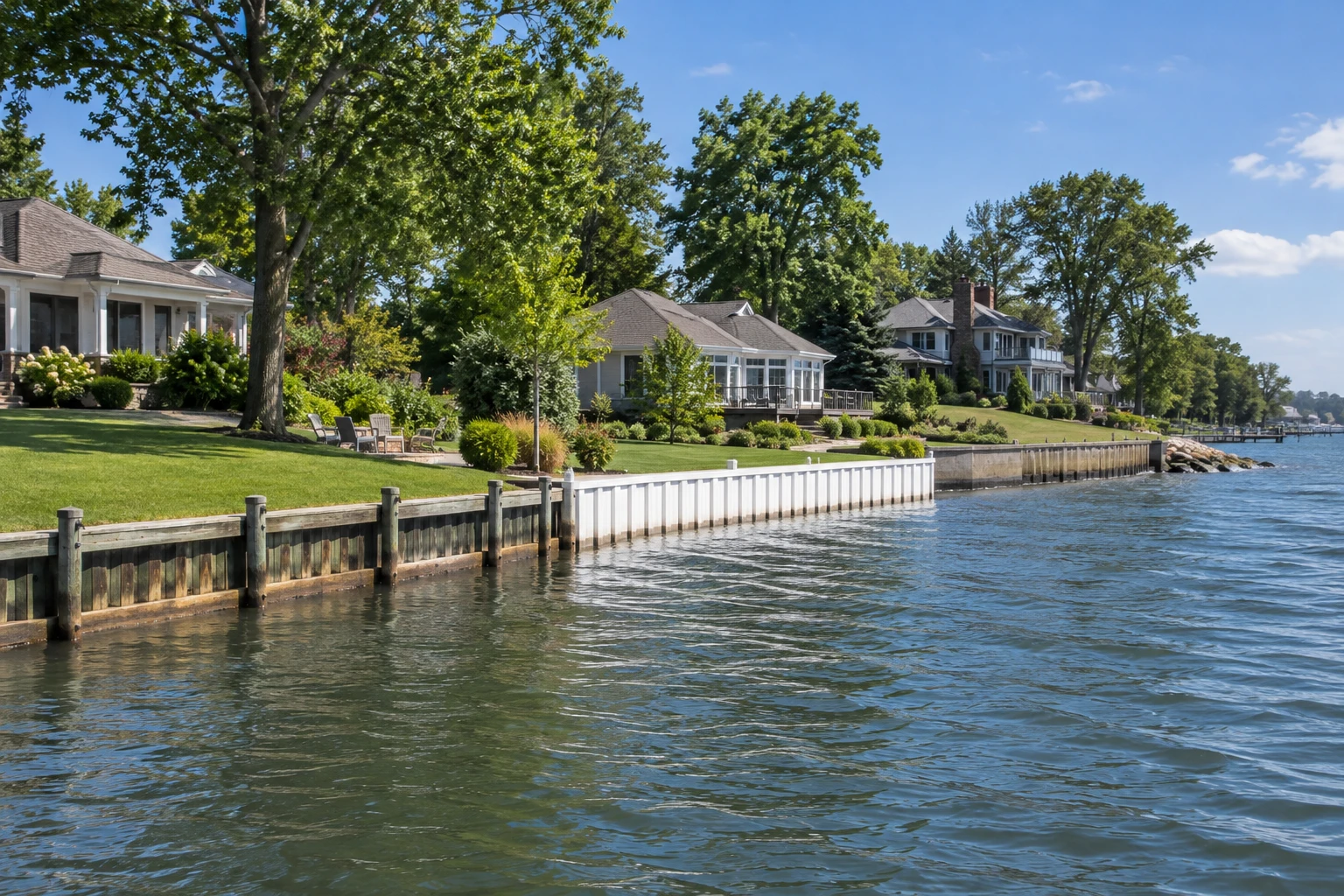
Bulkhead material selection becomes easier when the discussion starts with the water body instead of the material catalog. Shore Protect Team works on freshwater lakes, rivers, coastal areas, tidal zones, and open shorelines, and its bulkhead page connects different materials with different exposure and maintenance conditions.
The company’s waterfront construction solutions cover many types of shoreline projects, so bulkhead material should be selected in the context of how the property is actually used. A private lakefront lot, a river property, and a coastal commercial site may all need erosion control but face different water movement and maintenance priorities.
Wood is positioned for freshwater lakes and rivers with calm water. Vinyl is presented as suitable for many water bodies where durability and low maintenance are important. Concrete is identified for Gulf Coast areas and hurricane zones where exceptional strength is a leading requirement.
Riprap addresses active erosion and aggressive wave conditions by using natural stone and large boulders to absorb wave energy. Gabions use rock fill in a flexible system that provides natural drainage.
These categories are useful because they connect material properties to site conditions, but they do not replace soil, water-level, wave-load, and access assessment. The same water body can include protected and exposed locations.
The bulkhead material choices should therefore be treated as a set of tools rather than a ranking. The right choice is the one that fits the actual shoreline and the owner’s priorities.
Calm freshwater favors a different decision process
On calm lakes and rivers, wave load may be lower than on open coastal frontage. The service page identifies treated wood as a cost-effective option for these settings, with a stated service life of 40-50 years when properly maintained.
Vinyl can also be considered where the owner prioritizes a low-maintenance wall. The page describes vinyl as resistant to moisture and sun and requiring no additional care.
Coastal exposure changes what matters most
Gulf Coast and hurricane-zone properties put more emphasis on durability and extreme-weather performance. Reinforced concrete is presented as the strongest material option on the service page for those applications.
Open shoreline exposure can also shift attention toward energy absorption. Riprap is described as a solution for aggressive waves and active erosion because large stone and boulders absorb wave energy.
Drainage can point toward a different system
Gabion bulkheads are described as providing natural drainage and structural flexibility. That makes them distinct from rigid vertical walls when drainage and adaptability are important site considerations.
- Calm freshwater lakes and rivers – Wood is listed as an optimal application.
- Low-maintenance goals – Vinyl is presented as suitable across many water bodies.
- Gulf Coast and hurricane zones – Concrete is positioned for demanding exposure.
- Aggressive waves and active erosion – Riprap is associated with energy absorption.
- Natural drainage and flexibility – Gabions are identified for these priorities.
Material choice still depends on the foundation
A water-body match does not complete the design. Soil type can affect pile depth and reinforcement. Wall height and soil type affect anchor requirements. Groundwater pressure can require drainage. Access influences construction labor.
That means a material can be appropriate for the exposure but still require a foundation and reinforcement package tailored to the property.
- Classify the site as lake, river, tidal, bay, or open coastal shoreline.
- Assess wave load and changing water levels.
- Review soil type and foundation requirements.
- Define the owner’s maintenance priorities.
- Compare materials that fit both the exposure and the maintenance objective.
- Confirm anchors, drainage, and access before finalizing the scope.
A site-based material decision is easier to defend
When material is selected from site conditions, the reasoning is clear. Wood is not chosen merely because it has a lower starting price, and concrete is not chosen merely because it is stronger. Each is selected because its characteristics match the water body, exposure, structure, and ownership plan.
This approach also helps owners compare bids. If two contractors recommend different materials, the discussion can return to the same measurable conditions: water body, wave load, soil, drainage, maintenance, access, and expected use.
One property can justify more than one material discussion
Material selection does not always have to be treated as a winner-take-all comparison at the earliest stage. An owner can narrow the field by eliminating options that do not fit the water body or exposure, then compare the remaining systems on maintenance, appearance, access, and cost. That keeps the decision focused without forcing an artificial ranking.
For example, a calm freshwater property may reasonably compare treated wood with vinyl because both can fit the setting while creating different maintenance expectations. A more exposed site may shift the discussion toward concrete or rock-based stabilization. The useful comparison changes with the shoreline.
This staged approach also makes contractor recommendations easier to evaluate. Instead of asking which bulkhead is “best,” the owner can ask which materials satisfy the known site conditions and why one of those suitable options is being recommended for the final scope.
Appearance should be the final filter, not the first
Wood, vinyl, concrete, riprap, and gabions create very different shoreline appearances. That difference matters on a residential or commercial property, but it should be considered after the options have been narrowed by exposure, soil, drainage, maintenance, and required shoreline form. Visual preference is useful when choosing among suitable systems, not when overriding site conditions.

