

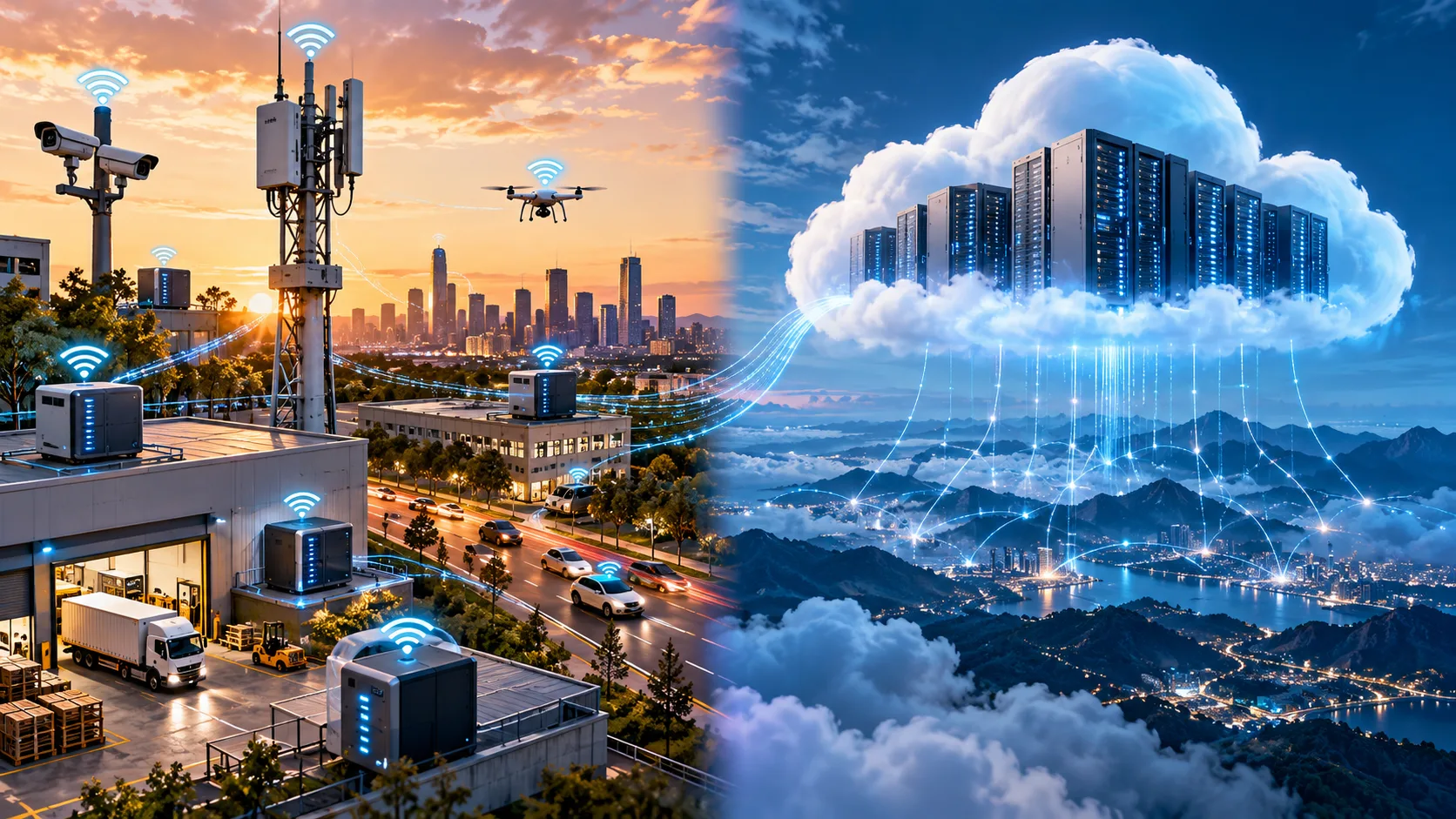
Modern businesses depend on fast, reliable computing systems to manage large amounts of data and deliver digital services. As connected devices, smart technologies, and Internet of Things (IoT) applications continue growing, organizations need effective ways to process information. This has made the comparison between fog computing vs cloud computing increasingly important for businesses planning their digital infrastructure.
Although both technologies support data processing, storage, and application management, they operate differently. Cloud computing relies on remote computing infrastructure, while fog computing distributes processing capabilities closer to connected devices and data sources. Understanding these differences helps organizations choose suitable solutions for real-time applications, network efficiency, security, and scalability.
What Is Fog Computing and How Does It Work?
Fog computing is a distributed computing architecture that extends cloud capabilities closer to the devices generating information. Instead of sending every piece of data to distant cloud servers, fog computing allows nearby network nodes to process and analyze information. These nodes may include gateways, routers, local servers, and other computing devices positioned between connected equipment and centralized cloud infrastructure.
The main purpose of fog computing is to reduce unnecessary communication delays and support applications requiring quick responses. For example, sensors inside a manufacturing facility can send operational information to a nearby fog gateway for immediate analysis. The gateway processes important signals locally while forwarding selected information to cloud systems for long-term storage and broader analysis.
Fog computing is particularly useful for environments containing large numbers of connected devices that continuously generate information. Smart cities, industrial automation systems, and connected transportation networks are common examples of environments that may benefit from this approach. By distributing computing tasks across nearby infrastructure, organizations can improve responsiveness while reducing dependence on continuous communication with remote servers.
What Is Cloud Computing and How Does It Work?
Cloud computing delivers computing resources such as servers, databases, storage, networking, and software through remote infrastructure. Instead of maintaining every computing system within their own facilities, organizations can access services provided by cloud platforms. These resources are commonly delivered over the internet, allowing users and businesses to manage applications and information from different locations.
Cloud computing environments generally rely on interconnected data centers that provide substantial processing capacity and flexible storage resources. Businesses can increase or decrease computing resources depending on changing workloads, application demands, and operational requirements. This flexibility makes cloud infrastructure attractive for hosting websites, managing business databases, running analytics platforms, and supporting software applications used by distributed teams.
A major advantage of cloud computing is the ability to manage extensive workloads without purchasing and maintaining all the underlying hardware. Cloud providers typically offer infrastructure management, resource allocation, backup options, and additional digital services. However, applications that continuously communicate with distant cloud servers may experience network delays, particularly when immediate responses or reliable connectivity are essential.
How Fog Computing and Cloud Computing Architectures Work
Fog computing and cloud computing use different approaches to positioning computing resources within a network. Cloud architecture commonly directs information toward centralized services hosted across regional or global data centers. Fog architecture introduces distributed processing resources closer to connected devices, allowing selected tasks to operate locally while other workloads continue using remote cloud infrastructure.
Consider a smart factory equipped with sensors that monitor machinery conditions and production performance. A fog computing system can analyze incoming sensor readings through nearby gateways and generate rapid alerts when unusual activity occurs. Meanwhile, the cloud platform can collect summarized information from multiple factories to identify long-term patterns, compare performance, and support strategic business decisions.
Fog computing is closely related to edge computing, but the terms are not always interchangeable. Edge computing generally emphasizes processing directly on devices or immediately adjacent equipment, while fog computing describes a broader distributed layer of connected computing resources. Both approaches can complement cloud services, creating flexible architectures that distribute workloads according to application requirements and network conditions.
Fog Computing vs Cloud Computing: Key Differences
The biggest difference between fog computing and cloud computing is where information gets processed and how resources are distributed. Fog computing places processing capabilities closer to connected devices, whereas cloud computing commonly uses remote infrastructure for application execution and data management. This architectural difference influences response times, bandwidth requirements, network dependencies, and the types of applications each approach supports.
Another important distinction involves how organizations handle information traveling across their networks. Fog systems can filter, analyze, and summarize selected data locally before transmitting it to cloud platforms. Cloud-based systems can receive information directly from devices or through intermediary services, depending on their architecture and the connectivity available to participating equipment.
Both technologies also differ in operational management and resource availability. Cloud platforms generally provide extensive computing capacity and standardized tools for scaling large applications, while fog infrastructure may involve numerous distributed devices with different capabilities. Neither approach is automatically superior because performance, reliability, security, and operating costs depend on how the overall system is designed.
Latency and Real-Time Performance Comparison
Latency refers to the delay between sending information and receiving or processing a response. In applications requiring immediate decisions, even relatively small delays can affect performance and user experience. Fog computing can reduce network-related latency by processing time-sensitive information near its source instead of waiting for communication with a remote cloud service.
For example, industrial monitoring equipment may need to detect unusual operating conditions and trigger alerts without unnecessary communication delays. A nearby fog node can process relevant measurements and support prompt responses within the local environment. Sending every sensor reading to a distant cloud platform could introduce additional network delays, especially when internet connectivity becomes unstable.
Cloud computing remains highly effective for applications that do not require immediate local responses, including reporting systems and many business applications. Its performance depends on server locations, network quality, workload design, and available computing resources. Organizations should evaluate actual application requirements rather than assuming that fog computing always delivers faster results in every possible situation.
Bandwidth, Data Processing, and Storage Differences
Connected devices can generate substantial volumes of information, especially when sensors, cameras, and industrial equipment operate continuously. Transferring every piece of information to cloud infrastructure may increase network bandwidth consumption and associated communication costs. Fog computing helps manage this challenge by allowing local nodes to process data and transmit only information needed for additional analysis.
For example, a smart building may contain hundreds of sensors monitoring temperature, lighting, occupancy, and equipment conditions. A fog gateway can analyze routine measurements locally while forwarding important events and summarized records to the cloud. This approach can reduce unnecessary data transmission while preserving information that supports maintenance planning, building management, and operational reporting.
Cloud computing offers significant advantages when organizations need scalable storage, historical analysis, or access to information across multiple locations. Cloud platforms can store extensive datasets and support advanced analytical workloads without requiring every local facility to maintain large storage systems. Combining local filtering with centralized storage often provides an effective balance between network efficiency and long-term data accessibility.
Security, Privacy, and Reliability in Fog and Cloud Computing
Security is an important consideration when comparing fog computing and cloud computing because both architectures handle potentially sensitive information. Fog computing can process selected data locally, reducing the amount of information transmitted beyond a facility or nearby network. This may support certain privacy requirements, although local processing alone does not guarantee stronger protection against unauthorized access.
Cloud computing platforms typically provide established security services, including identity management, encryption, monitoring, and configurable access controls. However, businesses must still manage permissions, application configurations, and data protection responsibilities correctly. Security outcomes depend on the provider, deployment design, and organizational practices rather than whether computing resources are located locally or remotely.
Fog infrastructure also creates security challenges because distributed gateways and local servers require regular maintenance and protection. Organizations must consider device authentication, software updates, physical security, and secure communication between computing nodes. In terms of reliability, local fog processing can maintain selected functions during connectivity interruptions, while cloud systems may provide resilient infrastructure for broader application services.
Cost, Scalability, and Maintenance Requirements
Cloud computing is often attractive because organizations can access computing infrastructure without purchasing large amounts of physical equipment. Many cloud services use consumption-based pricing, allowing businesses to pay according to resource usage and service agreements. However, ongoing storage, processing, network transfer, and subscription costs can increase as applications become more demanding or data volumes expand.
Fog computing may reduce certain communication expenses by processing information locally instead of transmitting everything to cloud systems. However, implementing distributed infrastructure requires investment in hardware, software, installation, monitoring, and maintenance. Managing multiple fog nodes across different locations can also increase operational complexity, especially when systems require specialized configuration or regular physical servicing.
Scalability is another important factor when selecting an appropriate computing architecture. Cloud services generally support rapid resource expansion through virtualized infrastructure and automated management tools, while fog deployments may require additional local equipment. Organizations should compare total ownership costs, expected workloads, maintenance responsibilities, and long-term growth requirements before deciding which approach offers better financial value.
Real-World Applications of Fog Computing
Fog computing is particularly useful in smart city projects that rely on numerous connected systems operating across different locations. Traffic monitoring equipment, environmental sensors, and public infrastructure can generate information requiring timely local analysis. Distributed fog nodes can process selected measurements near collection points while sharing broader trends with centralized platforms responsible for citywide planning and management.
Industrial Internet of Things applications also benefit from fog computing because manufacturing systems frequently require dependable local communication. Connected machinery can generate operational readings that help identify unusual conditions, coordinate equipment, and support maintenance decisions. Processing time-sensitive information near production equipment can reduce dependence on distant networks while cloud systems handle historical records and facility-wide performance analysis.
Healthcare facilities, agricultural operations, and connected transportation systems are additional environments where fog computing may provide practical advantages. Local processing can support equipment monitoring, agricultural sensors, or transport infrastructure when low-latency decisions are important. However, applications involving safety-critical decisions require carefully validated systems, appropriate safeguards, and reliable operating procedures beyond simply adopting fog architecture.
When Cloud Computing Is the Better Choice
Cloud computing is often the better choice for organizations that need substantial processing resources, flexible infrastructure, and centralized information management. Businesses operating websites, collaboration applications, or customer databases can benefit from remotely hosted services. These workloads typically require dependable availability and efficient resource management rather than immediate communication with physical devices located at the network edge.
Large-scale analytics and artificial intelligence workloads also frequently benefit from the computing capacity available through cloud platforms. Organizations can combine information from different branches, process extensive historical datasets, and build predictive models using specialized infrastructure. Cloud environments also support collaboration by allowing authorized users to access shared applications and resources from different geographic locations.
Cloud computing can also simplify technology deployment for smaller businesses that do not want to maintain extensive local infrastructure. Managed services may reduce the effort required for server maintenance, software updates, and infrastructure monitoring. Nevertheless, businesses should assess internet connectivity, data protection requirements, service agreements, and ongoing expenses to ensure their selected cloud solutions remain suitable.
How to Choose Between Fog Computing, Cloud Computing, and Hybrid Solutions
Choosing between fog computing and cloud computing begins with understanding the requirements of your applications and connected devices. Organizations should consider response-time expectations, data volumes, available connectivity, security obligations, and operational budgets. If an application requires reliable local processing and generates continuous sensor information, a fog-based architecture may provide meaningful advantages over a cloud-only approach.
For applications requiring centralized access, extensive storage, and scalable computing resources, cloud infrastructure may be more practical. Many organizations benefit from combining the two approaches through a hybrid architecture that assigns different responsibilities to local and remote systems. Fog nodes can handle immediate processing while cloud platforms manage historical information, advanced analytics, and broader resource coordination.
Before implementing either technology, businesses should test representative workloads under realistic operating conditions and evaluate potential failure scenarios. Monitoring response times, bandwidth usage, security controls, and maintenance requirements helps identify suitable deployment options. A well-designed computing strategy focuses on delivering dependable application performance rather than choosing a technology simply because it appears more advanced.
Conclusion
Understanding fog computing vs cloud computing helps organizations make informed decisions about modern computing infrastructure. Fog computing brings selected processing tasks closer to connected devices, supporting low-latency applications and more efficient local data handling. Cloud computing provides scalable resources, centralized services, and extensive storage capabilities that support a wide range of business workloads.
The most important differences involve resource location, network dependency, scalability, operational management, and application response requirements. Fog architecture can offer advantages for industrial automation, IoT environments, and other distributed systems, while cloud platforms remain valuable for large-scale applications and centralized analytics. Both approaches have limitations that organizations must consider during planning and implementation.
Rather than treating these technologies as competing alternatives, businesses can often achieve better results by using them together. Combining fog and cloud computing allows local systems to handle time-sensitive operations while remote infrastructure manages resource-intensive tasks. Selecting the right architecture depends on actual operational needs, available resources, security responsibilities, and long-term technology goals.
Frequently Asked Questions About Fog Computing vs Cloud Computing
What Is the Main Difference Between Fog Computing and Cloud Computing?
Fog computing processes selected information closer to connected devices using distributed computing nodes. Cloud computing relies on remote infrastructure for processing and storage, making it particularly suitable for scalable applications and centralized services.
Is Fog Computing Faster Than Cloud Computing?
Fog computing can deliver lower network-related latency when applications require nearby processing and immediate responses. However, actual performance depends on hardware capacity, network conditions, workload complexity, and the overall system architecture.
Is Fog Computing the Same as Edge Computing?
No, although the technologies are closely related. Edge computing emphasizes processing directly on or near devices, while fog computing typically describes a broader distributed architecture connecting local processing resources with cloud infrastructure.
What Are the Main Advantages of Fog Computing?
Fog computing can reduce network latency, limit unnecessary data transmission, and support selected applications during internet connectivity interruptions. These benefits make it useful for industrial systems, connected devices, and time-sensitive monitoring applications.
Can Fog Computing and Cloud Computing Work Together?
Yes, fog and cloud computing can operate together within a hybrid architecture. Fog nodes handle selected local processing tasks, while cloud platforms provide centralized storage, extensive computing resources, and advanced data analysis.

