

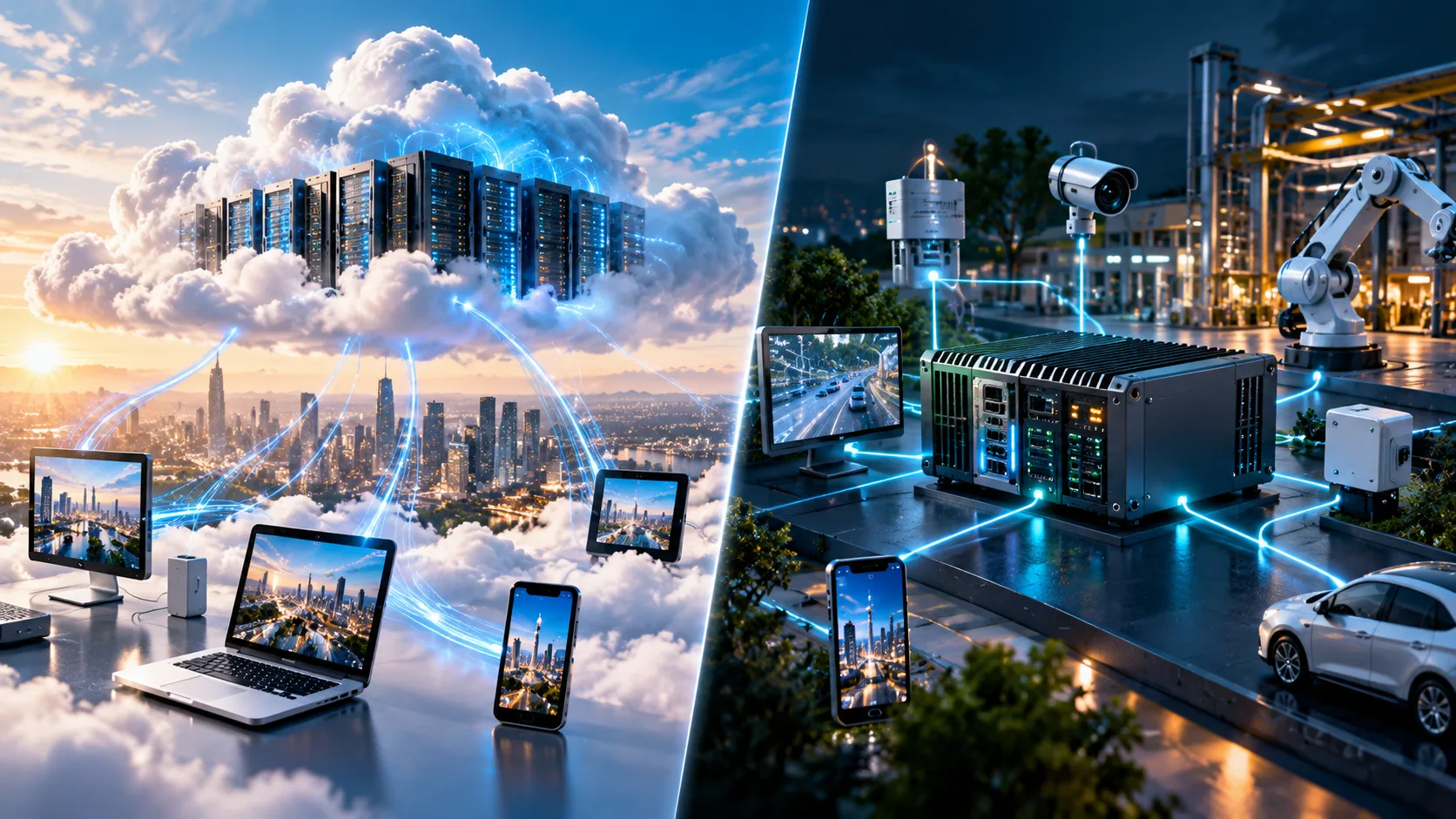
Cloud computing and edge computing are two important technologies that influence how modern businesses store, process, and manage digital information. Both approaches provide powerful computing capabilities, but they differ significantly in where data processing occurs. Cloud computing typically relies on centralized data centers, while edge computing processes information closer to users, devices, or the locations where data is generated.
When comparing cloud computing vs edge computing, speed is often the biggest consideration. Edge computing can provide faster response times for certain applications because it reduces the distance data must travel. However, cloud computing offers powerful processing resources and extensive scalability that may deliver better performance for complex workloads. This guide explains the differences between cloud and edge computing, including latency, processing speed, performance, security, costs, and practical use cases.
What Is Cloud Computing?
Cloud computing is a technology that allows individuals and businesses to access computing resources through the internet instead of relying entirely on local hardware. These resources may include servers, storage systems, databases, networking tools, and software applications. Cloud service providers operate data centers that deliver computing capabilities according to customer requirements.
One major advantage of cloud computing is its flexibility because organizations can increase or decrease resources without purchasing additional physical servers. Businesses use cloud platforms for hosting websites, storing information, running applications, and analyzing large datasets. This approach can reduce the need to maintain extensive computing infrastructure within individual offices.
Cloud computing commonly operates through public, private, or hybrid deployment models. Public cloud services share provider-managed infrastructure among customers, while private clouds serve individual organizations. Hybrid cloud environments combine different infrastructure types to support business requirements involving scalability, security, performance, and data management.
What Is Edge Computing?
Edge computing is a computing approach that processes data closer to its source rather than sending every request to a distant centralized data center. Processing may occur on local devices, nearby servers, gateways, or regional infrastructure. This arrangement can reduce network communication delays and improve responsiveness for applications that depend on timely information.
For example, a smart manufacturing system may use nearby computing hardware to analyze sensor information without sending every measurement to a remote server. Local processing allows the system to respond more quickly to certain operating conditions. Selected information can still be transferred to cloud infrastructure for longer-term storage and broader analysis.
Edge computing is commonly associated with Internet of Things devices, industrial automation, video processing, and real-time applications. However, edge systems differ considerably in processing power, connectivity, and management requirements. Their effectiveness depends on placing appropriate workloads near the data source while maintaining reliable communication with other systems.
Cloud Computing vs Edge Computing: Key Differences
The primary difference between cloud computing and edge computing is the location where information is processed. Cloud computing typically uses provider-managed data centers that may be geographically distant from users. Edge computing moves selected processing tasks closer to devices or end users to reduce unnecessary data transmission.
Another major difference involves resource availability and infrastructure management. Cloud platforms generally provide access to large pools of computing power, storage, and specialized services. Edge systems often operate with more limited local resources but can respond more quickly when processing information nearby is more important than accessing extensive centralized infrastructure.
Both technologies support modern digital applications, but they solve different performance challenges. Cloud computing is commonly preferred for large-scale processing and centralized operations, while edge computing can improve responsiveness for time-sensitive tasks. Many organizations combine both approaches rather than treating them as completely separate alternatives.
Which Is Faster: Cloud Computing or Edge Computing?
Edge computing is generally faster when the main requirement is minimizing network latency between a device and its processing system. By handling information closer to the source, edge infrastructure can reduce round-trip communication time. This advantage is especially important when an application must respond rapidly to frequent requests or changing local conditions.
Cloud computing can be faster for workloads requiring extensive processing power, such as large-scale data analysis or training complex artificial intelligence models. Powerful cloud servers can complete demanding calculations more efficiently than smaller edge devices. Therefore, processing speed and response time must be considered separately when comparing these technologies.
The fastest option depends on the application’s workload, infrastructure, connectivity, and performance requirements. A nearby edge server may respond quickly to a simple request, while a powerful cloud cluster may complete a difficult computation sooner. Accurate comparisons require measuring the entire process rather than assuming one technology is always faster.
Understanding Latency in Cloud and Edge Computing
Latency refers to the delay involved in transmitting information or receiving a response from a computing system. In network applications, latency is commonly measured in milliseconds. Lower latency is important for interactive software because excessive delays can affect responsiveness, user experience, and the reliability of time-sensitive operations.
Cloud applications may experience additional latency when data travels between users and geographically distant data centers. Network congestion, routing paths, and communication protocols can contribute to these delays. However, cloud providers often operate multiple regional locations, allowing organizations to choose infrastructure closer to their primary users.
Edge computing can reduce latency by processing selected information at nearby locations. This reduces the need for repeated communication with distant servers, although it does not eliminate processing delays or network limitations. Measuring actual response times remains essential because poor application design can produce slow performance even when computing resources are physically nearby.
Data Processing Speed: Cloud vs Edge
Data processing speed describes how quickly computing systems perform calculations and complete assigned workloads. Cloud platforms commonly provide powerful processors, extensive memory, and specialized hardware that support demanding computational tasks. These resources can be particularly valuable when handling large datasets or performing complex calculations.
Edge computing systems are often designed for specific workloads rather than unlimited processing capacity. A nearby edge device may process sensor information or perform simple machine learning inference efficiently. However, it may struggle with applications requiring substantial memory, specialized accelerators, or large-scale parallel processing resources.
The performance difference depends on the computational complexity of each task. Edge computing may provide a faster result when reduced network delays outweigh limited processing capacity. Cloud computing may perform better when powerful infrastructure significantly reduces calculation time, even after accounting for the additional communication required.
How Network Distance Affects Computing Performance
Physical distance influences network performance because information requires time to travel between devices and servers. Data packets move through communication networks, routers, and other infrastructure before reaching their destination. Longer network paths generally introduce more opportunities for delays, although routing efficiency and network quality also affect actual performance.
Cloud computing applications hosted far from their users may experience noticeable communication delays during repeated interactions. This can influence online applications that require frequent requests between a device and a server. Selecting a closer cloud region or using distributed delivery infrastructure can reduce some of these limitations.
Edge computing addresses distance-related challenges by placing suitable processing resources near users or connected devices. However, physical proximity does not guarantee the best performance if local infrastructure is overloaded or poorly connected. Developers must evaluate both network distance and computing efficiency when optimizing application response times.
Cloud Computing vs Edge Computing for Real-Time Applications
Real-time applications require information to be processed and delivered within specific timing requirements. Examples include industrial monitoring, certain robotics systems, and interactive digital services. These applications may experience problems when important responses depend on communication with distant infrastructure or unreliable network connections.
Edge computing is often suitable for time-sensitive workloads because local processing reduces dependence on long-distance communication. For example, industrial equipment may use local computing systems to detect abnormal sensor readings quickly. Processing essential information nearby can support timely responses without requiring every decision to pass through centralized cloud services.
Cloud computing remains useful for supporting real-time systems through centralized monitoring, historical analysis, and resource coordination. However, applications with strict timing requirements may need local processing and specialized control systems. Combining edge devices with cloud services can provide a practical balance between immediate responsiveness and broader operational capabilities.
Cloud vs Edge Computing for Artificial Intelligence
Artificial intelligence applications use computing resources for tasks such as model training, prediction, classification, and automated data analysis. Cloud platforms are particularly useful for training large AI models because they provide scalable processors, graphics processing units, and specialized computing infrastructure. These resources support computationally intensive operations involving extensive datasets.
Edge computing is often used for AI inference, where an already-trained model analyzes new information near its source. Examples include image recognition on smart cameras and selected functions in connected devices. Local inference can reduce network delays and limit the amount of information transmitted to remote infrastructure.
Not every AI model can operate efficiently on edge hardware because memory requirements and computational complexity vary. Smaller models may be optimized for local execution, while larger systems continue to require cloud resources. A hybrid architecture often combines centralized training with distributed inference to support performance and operational requirements.
Cloud Computing vs Edge Computing for IoT Devices
Internet of Things devices generate information through sensors, connected appliances, monitoring systems, and industrial equipment. These devices may transmit frequent measurements that require processing, analysis, or storage. Sending every individual measurement to a distant cloud service can increase network traffic and create unnecessary communication delays.
Edge computing allows selected IoT information to be processed locally before transmission to central systems. A nearby gateway may filter routine measurements and forward only relevant summaries or alerts. This approach can reduce bandwidth consumption while supporting faster responses to particular operating conditions.
Cloud computing remains valuable for managing large collections of IoT devices and analyzing information from multiple locations. Centralized systems can identify broader patterns, store historical measurements, and coordinate software updates. Combining cloud and edge computing allows organizations to balance local responsiveness with centralized data management.
Cloud Computing vs Edge Computing for Gaming
Gaming applications often require responsive communication between players, game servers, and digital environments. High latency can contribute to delays between player actions and the responses displayed in a game. Network conditions, server locations, and processing capacity all influence the resulting gaming experience.
Edge computing can reduce communication delays when game-related processing occurs close to players. Regional servers and distributed infrastructure may improve responsiveness compared with distant centralized locations. However, the actual performance improvement depends on network routing, server load, and how the gaming application is designed.
Cloud computing provides scalable infrastructure for game hosting, multiplayer services, and other demanding workloads. Cloud gaming can also require substantial bandwidth because visual information is streamed to users. Combining geographically distributed resources with powerful centralized systems may help developers support responsive gameplay and reliable online services.
Cloud Computing vs Edge Computing for Websites
Website performance depends on server response times, network conditions, content size, caching, and application design. Traditional cloud hosting provides computing resources for websites, databases, and backend applications. When users are geographically distant from the hosting region, network delays may influence the time required to receive requested information.
Edge computing can improve selected website operations by serving cached content or executing lightweight application logic closer to visitors. Content delivery networks commonly distribute images, scripts, and other static resources across multiple locations. This approach reduces unnecessary communication with distant origin servers and can improve page-loading performance.
However, edge processing does not automatically improve every website operation. Dynamic requests that require distant databases or complex backend services may still experience latency. Website owners should optimize caching, code efficiency, server configuration, and data access patterns rather than assuming edge deployment alone will solve all performance problems.
Scalability Differences Between Cloud and Edge Computing
Scalability describes how effectively a computing system can increase or decrease resources as demand changes. Cloud computing offers extensive scalability through provider-managed infrastructure that can allocate additional processing capacity, memory, and storage. This flexibility helps businesses support changing workloads without constantly purchasing new physical equipment.
Edge computing scales differently because processing resources are distributed across multiple locations. Adding capacity may involve deploying more devices, upgrading local hardware, or expanding regional edge infrastructure. This can require additional coordination, particularly when hundreds or thousands of separate systems must be maintained.
Cloud platforms are generally convenient for scaling centralized applications, while edge computing can distribute workload demands geographically. Organizations may combine both approaches by processing routine data locally and transferring demanding tasks to cloud systems. This strategy can provide scalable operations while maintaining appropriate responsiveness across distributed locations.
Cost Comparison: Cloud Computing vs Edge Computing
Cloud computing commonly uses subscription-based or consumption-based pricing models that charge for resources such as processing, storage, and network usage. Businesses can begin without purchasing extensive physical infrastructure. However, ongoing resource consumption and data transfer charges can increase expenses as applications become more demanding.
Edge computing may reduce certain cloud transmission costs by processing information locally and sending less data across wide-area networks. However, deploying edge infrastructure can involve hardware purchases, installation, maintenance, and software management. Costs depend on whether the system uses existing devices, regional provider infrastructure, or dedicated local servers.
The most economical approach depends on workload size, data volume, network requirements, and infrastructure ownership. Cloud computing may be more affordable for centralized services with unpredictable demand. Edge computing may offer advantages when local processing significantly reduces transmission costs, but a complete cost comparison should include ongoing operational responsibilities.
Security Differences Between Cloud and Edge Computing
Cloud computing security commonly relies on centralized identity management, encryption, access controls, and infrastructure monitoring. Major cloud platforms provide numerous tools for protecting applications and stored information. However, customers remain responsible for correctly configuring services and managing security requirements within the provider’s shared responsibility model.
Edge computing can reduce the need to transmit certain sensitive information to distant systems by processing it locally. This may support specific privacy or data residency requirements. However, distributing processing across many physical devices can also increase the number of systems requiring updates, monitoring, and protection.
Neither computing model is automatically more secure in every situation. Cloud systems can experience configuration problems, while edge devices may face physical access risks and inconsistent maintenance. Organizations should apply appropriate encryption, authentication, software updates, and monitoring practices based on their actual infrastructure and threat exposure.
Reliability and Internet Connectivity Requirements
Cloud computing applications often depend on reliable network connectivity to access remote services and centralized resources. Internet interruptions can reduce availability when essential functions require continuous communication with cloud infrastructure. However, major providers offer redundancy and disaster recovery options that can improve overall service resilience.
Edge computing can allow selected functions to continue operating locally during temporary internet disruptions. For example, certain monitoring systems can process information without constantly contacting remote servers. However, local hardware failures or unavailable network resources can still interrupt operations, making appropriate redundancy important.
Hybrid systems can improve reliability by separating immediate local processing from centralized services. Essential functions may continue at the edge while cloud synchronization resumes when connectivity returns. The effectiveness of this arrangement depends on application design, data consistency requirements, and the ability to recover safely from interruptions.
Cloud Computing vs Edge Computing for Big Data
Big data applications process large volumes of information collected from many sources. Cloud computing is particularly suitable for these workloads because it provides scalable storage and powerful analytical tools. Organizations can combine information from different locations and perform extensive processing without operating all computational resources locally.
Edge computing supports big data systems by filtering, organizing, or summarizing information before transmitting it to centralized platforms. This can reduce unnecessary data movement and help identify important events close to their source. Local preprocessing may also reduce the volume of information that must be stored and analyzed in the cloud.
However, edge devices generally do not replace the extensive computational capabilities required for large-scale analytics. Complex historical analysis and cross-location data processing often remain better suited to centralized infrastructure. A combined architecture allows businesses to process immediate information locally while performing broader analysis in cloud environments.
Advantages and Disadvantages of Cloud Computing
One major advantage of cloud computing is access to scalable computing resources without maintaining extensive local infrastructure. Organizations can deploy applications, store large datasets, and use specialized software services. Cloud platforms also support centralized management and can simplify infrastructure expansion when workloads increase.
Cloud computing has limitations involving internet dependency, data transfer costs, and potential communication delays. Applications may perform less efficiently when users or connected devices are far from the selected data center. Businesses must also manage security configurations and ensure that stored information meets relevant legal and operational requirements.
Despite these challenges, cloud computing remains valuable for applications requiring flexibility, substantial processing capacity, and centralized data management. The strongest results often come from choosing appropriate service configurations and geographic regions. Understanding workload requirements helps organizations maximize cloud benefits while managing cost and performance limitations.
Advantages and Disadvantages of Edge Computing
One important advantage of edge computing is the ability to reduce latency by processing information near users or data sources. This supports applications that need timely responses without frequent communication with distant servers. Local processing can also reduce certain bandwidth requirements by limiting unnecessary data transmission.
The disadvantages include limited hardware resources, distributed maintenance requirements, and potentially greater operational complexity. Organizations may need to manage software updates, monitoring, and security across numerous physical locations. Smaller edge devices can also struggle with highly demanding workloads that require specialized computing infrastructure.
Edge computing is particularly valuable when low latency, local processing, and reduced data transmission provide meaningful benefits. However, it may not be the best solution for centralized analytics or large-scale model training. Businesses should evaluate performance requirements and maintenance capabilities before deciding how extensively to distribute computing resources.
Can Cloud Computing and Edge Computing Work Together?
Cloud computing and edge computing are frequently used together because they address different technical requirements. Edge infrastructure can handle immediate processing near devices, while cloud services provide centralized storage, management, and analytical capabilities. This hybrid approach allows organizations to place workloads where they can operate most effectively.
For example, a manufacturing business may process sensor information locally to support time-sensitive monitoring. Relevant summaries can then be transferred to a cloud platform for historical analysis and reporting. This arrangement can reduce communication delays without sacrificing access to powerful centralized computing resources.
Hybrid cloud-edge systems require careful planning around connectivity, security, application design, and data synchronization. Organizations must determine which tasks should run locally and which benefit from centralized infrastructure. When designed appropriately, the combined approach can deliver both responsive operations and scalable processing capabilities.
How to Choose Between Cloud and Edge Computing
Choosing between cloud and edge computing begins with identifying application performance requirements. Consider whether the workload needs immediate responses, substantial computing resources, or centralized access to large datasets. The importance of network latency and the volume of information transmitted can strongly influence the appropriate architecture.
Businesses should also evaluate infrastructure costs, maintenance responsibilities, security requirements, and available connectivity. Cloud computing may suit organizations seeking scalable services with limited local hardware management. Edge computing may be appropriate when applications require nearby processing or must continue selected operations during network interruptions.
A performance assessment can help determine which model provides the best results. Testing representative workloads under realistic conditions reveals how processing time, network delays, and resource limitations affect overall responsiveness. In many situations, combining cloud and edge resources offers a more effective solution than choosing one approach exclusively.
Conclusion
Cloud computing and edge computing are essential technologies that support different types of digital workloads. Edge computing generally offers faster response times for applications where nearby processing reduces network latency. Cloud computing, however, can provide superior performance for demanding calculations that benefit from powerful centralized infrastructure and extensive processing resources.
The best option depends on whether speed refers to network responsiveness or computational processing capacity. Edge systems can support real-time applications, connected devices, and localized information processing. Cloud platforms remain valuable for large-scale analytics, centralized storage, artificial intelligence training, and applications requiring flexible resource allocation.
Rather than viewing cloud and edge computing as competing technologies, organizations can benefit from combining their strengths. A well-designed hybrid architecture can support low-latency operations while retaining scalable cloud capabilities. Understanding application requirements, connectivity, costs, and security considerations helps businesses choose the most effective computing strategy.
Frequently Asked Questions (FAQs)
1. Is Edge Computing Faster Than Cloud Computing?
Edge computing is generally faster for applications requiring low network latency because processing occurs closer to users or devices. Cloud computing may be faster for computationally demanding workloads requiring powerful infrastructure.
2. What Is the Main Difference Between Cloud and Edge Computing?
Cloud computing typically processes information in centralized data centers, while edge computing processes selected workloads near users or data sources. Their main differences involve processing location, latency, scalability, and infrastructure management.
3. Is Edge Computing Better for Real-Time Applications?
Edge computing is often suitable for real-time applications because local processing can reduce communication delays. However, performance depends on system design, available processing resources, and specific timing requirements.
4. Is Cloud Computing Cheaper Than Edge Computing?
Cloud computing can reduce initial hardware expenses, while edge computing may lower certain bandwidth and data transmission costs. The more affordable option depends on workload requirements, infrastructure, and ongoing maintenance.
5. Can Edge Computing Replace Cloud Computing?
Edge computing generally complements rather than completely replaces cloud computing. Many applications benefit from local processing for responsiveness and centralized cloud infrastructure for storage, analytics, scalability, and management.

