

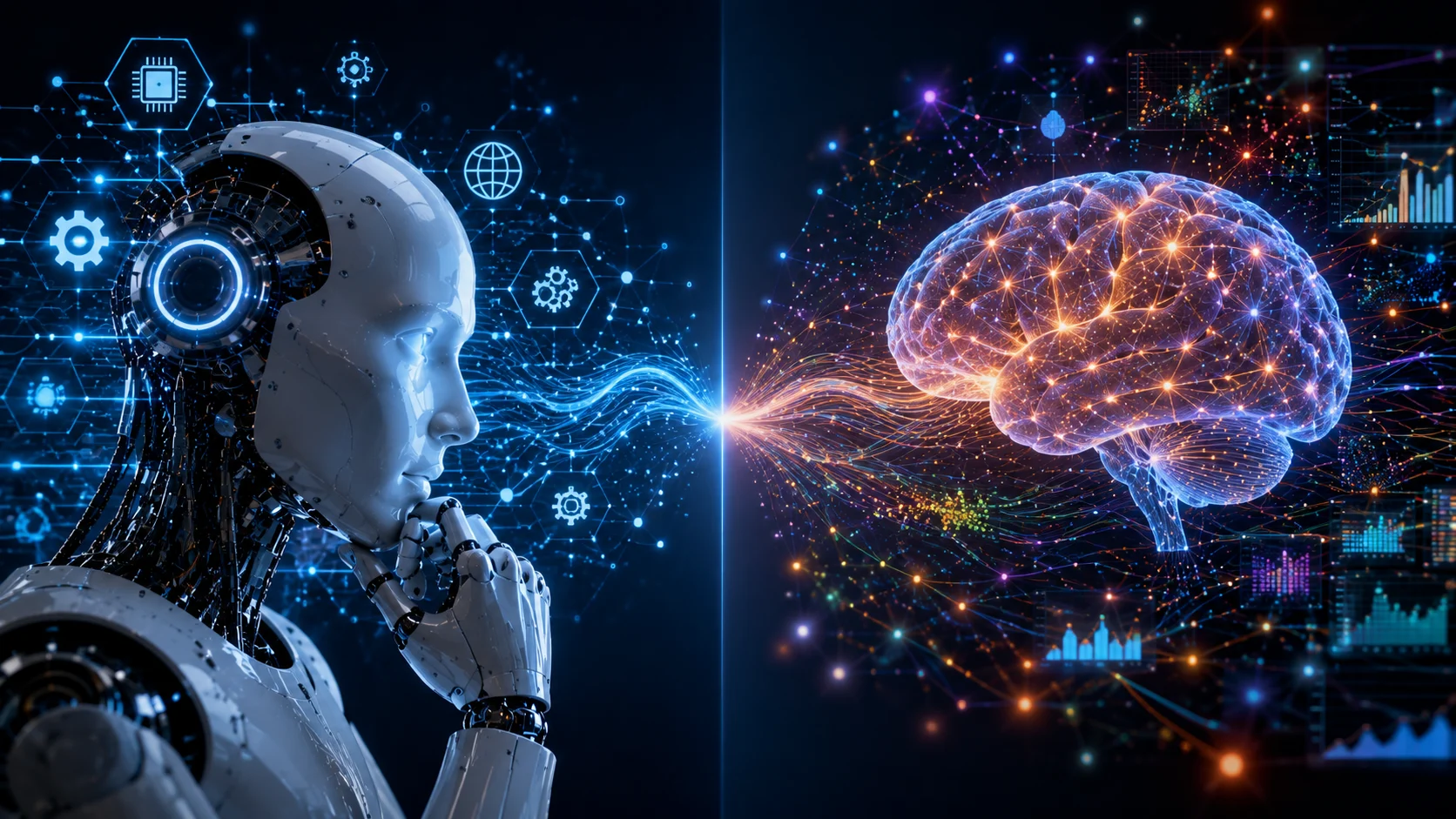
AI vs Machine Learning: What’s the Difference?
Artificial intelligence and machine learning are often mentioned together, which can make them sound like two names for the same technology. They are closely related, but they are not identical. Artificial intelligence is the broader concept of creating computer systems that can perform tasks associated with human intelligence, while machine learning is one of the main methods used to build those intelligent systems. AI can include reasoning, planning, language understanding, computer vision, robotics, expert systems, and automation. Machine learning focuses more specifically on enabling computers to learn patterns from data and improve their performance without being programmed with a separate rule for every situation. Understanding the difference between AI vs machine learning makes it easier to understand modern technology, business automation, generative AI, and data-driven decision-making.
The distinction matters because companies increasingly use terms such as artificial intelligence, machine learning, deep learning, generative AI, neural networks, predictive analytics, and automation interchangeably. A customer recommendation system may rely on machine learning, while a conversational assistant may combine machine learning with natural language processing and other AI techniques. A factory robot may use computer vision, planning algorithms, sensors, and machine learning at the same time. Knowing how these technologies fit together helps businesses choose appropriate tools and prevents unrealistic expectations about what AI can actually do. It also makes discussions about jobs, automation, cybersecurity, healthcare, and the future of technology easier to understand. The simplest starting point is that machine learning sits inside the wider field of artificial intelligence, but the practical relationship between them deserves a closer look.
What Is Artificial Intelligence?
Artificial intelligence is the broad field focused on creating machines capable of performing tasks that normally require some form of human intelligence. These tasks can include understanding language, recognizing images, solving problems, making decisions, planning actions, learning from experience, and interacting with the physical world. An AI system does not need to think exactly like a human to qualify as artificial intelligence. It only needs to demonstrate capabilities that appear intelligent within a particular context. A navigation system choosing an efficient route, a chatbot answering questions, and a computer vision system identifying objects are all examples of AI applications. The methods behind those systems can vary considerably. Some depend heavily on machine learning, while others may rely on rules, optimization methods, search algorithms, or combinations of several technologies.
Artificial intelligence has existed as a field for decades, long before modern machine learning became dominant. Early AI researchers often attempted to reproduce intelligent behavior by writing explicit rules that computers could follow. An expert system, for example, might contain hundreds or thousands of statements describing how to respond to specific conditions. These programs could perform useful specialized tasks but often struggled when they encountered situations outside their predefined rules. Modern AI increasingly relies on systems that learn from data because real-world problems are often too complicated to describe through hand-written instructions alone. Nevertheless, rule-based AI still exists and can be useful where decisions must follow clear, predictable logic. This history demonstrates why artificial intelligence is broader than machine learning and should not be defined solely by today’s neural networks.
AI can be divided into narrow artificial intelligence and more hypothetical forms such as artificial general intelligence. Narrow AI is designed to perform specific tasks or categories of tasks. Most systems available today fall into this category, even when they demonstrate impressive capabilities across language, coding, images, and analysis. Artificial general intelligence, or AGI, generally refers to a system capable of handling a broad range of intellectual activities with flexibility comparable to human intelligence. Researchers disagree about exactly how AGI should be defined or measured. Superintelligence is an even more speculative idea involving systems that exceed human capabilities across most important cognitive areas. These categories are useful because they remind people that today’s AI systems can be extraordinarily powerful without necessarily possessing every characteristic associated with human intelligence.
Generative AI is another important part of the broader artificial intelligence landscape. Generative systems can produce new material such as text, images, audio, video, software code, and other digital content. Large language models are a well-known example because they learn statistical relationships within enormous collections of language and use those patterns to generate responses. Generative AI became particularly important because people can interact with these systems through ordinary language instead of specialized programming interfaces. However, generating content is only one AI capability. Artificial intelligence also powers fraud detection, recommendation systems, predictive maintenance, medical image analysis, autonomous navigation, and industrial automation. Understanding this broader definition prevents AI from being reduced to chatbots alone. AI represents an entire family of technologies designed to perform intelligent functions.
The goal of artificial intelligence is therefore usually defined by capability rather than by one particular technical method. If a system can recognize speech, plan routes, recommend products, or reason through information, it may be described as AI regardless of exactly how that capability is implemented. Machine learning has become one of the most successful ways to achieve these capabilities because it allows systems to improve through data rather than depending entirely on handcrafted rules. However, AI systems often combine multiple approaches. A modern autonomous robot may use machine learning for perception, traditional algorithms for path planning, programmed safety rules, and optimization techniques for movement. Artificial intelligence is best understood as the larger objective of creating intelligent behavior, while machine learning is one powerful tool used to reach that objective.
What Is Machine Learning?
Machine learning is a branch of artificial intelligence that enables computer systems to identify patterns in data and use those patterns to make predictions, classifications, recommendations, or decisions. Instead of programming a separate rule for every possible situation, developers provide examples or data from which the system can learn. A machine learning model might study previous customer transactions and learn patterns associated with fraud. Another model could analyze historical sales and predict future demand. The model does not understand these activities exactly the way a human expert does, but it can detect statistical relationships that help it produce useful outputs. Machine learning is especially valuable when datasets are too large, complicated, or variable for traditional rule-based programming to handle efficiently.
Training is a central concept in machine learning. During training, an algorithm processes examples and adjusts internal parameters so its predictions become more accurate according to a defined objective. A spam filter, for example, might learn from thousands of messages labeled as spam or legitimate email. Over time, it identifies combinations of words, formatting patterns, sender information, and other signals that distinguish suspicious messages. When the trained model receives a new email, it estimates which category is most appropriate based on patterns learned previously. The model does not require developers to write a rule for every possible spam message. This ability to generalize from examples is what makes machine learning powerful. However, its performance depends heavily on the quality, quantity, and relevance of the training data.
Machine learning is commonly divided into supervised learning, unsupervised learning, and reinforcement learning. Supervised learning uses examples containing known answers, such as historical transactions labeled fraudulent or legitimate. Unsupervised learning attempts to discover patterns or groups within data without predefined labels, making it useful for tasks such as customer segmentation. Reinforcement learning involves an agent learning through interactions with an environment and receiving rewards or penalties based on its actions. Each approach works well for different problems, and modern AI systems may combine several techniques. Machine learning practitioners select algorithms according to the available data, desired outcome, computing resources, and acceptable level of error. This makes machine learning a technical discipline involving statistics, mathematics, software engineering, data preparation, experimentation, and continuous evaluation.
Deep learning is a specialized type of machine learning based on artificial neural networks containing many computational layers. These systems have become particularly effective for complex tasks involving images, speech, language, and other forms of unstructured information. Deep learning helped drive major advances in computer vision, voice recognition, translation, and generative AI because neural networks can learn sophisticated representations from enormous datasets. Large language models are built using deep learning techniques, making them part of machine learning as well as artificial intelligence. The relationship can therefore be visualized as nested categories: deep learning sits inside machine learning, while machine learning sits inside artificial intelligence. Not every AI application uses deep learning, and not every machine learning problem requires large neural networks. Simpler models can sometimes be faster, cheaper, and easier to interpret.
Machine learning should also be distinguished from ordinary software automation. Traditional software follows programmed rules such as “if this condition occurs, perform this action.” Machine learning can discover relationships from historical examples and make decisions even when developers cannot write every rule explicitly. A traditional discount system might offer ten percent off when a customer spends more than a fixed amount. A machine learning system could analyze thousands of customer characteristics to estimate which promotion is most likely to produce a purchase. Both systems automate decisions, but only the second learns patterns from data. This distinction becomes important because machine learning introduces uncertainty. Predictions are probabilistic rather than guaranteed, meaning organizations need testing, monitoring, and human oversight when mistakes could have meaningful consequences.
AI vs Machine Learning: The Key Differences
The most important difference between AI and machine learning is scope. Artificial intelligence is the broader field concerned with creating systems that perform intelligent tasks, while machine learning is one approach used to build those systems. AI includes technologies related to reasoning, planning, language processing, robotics, computer vision, expert systems, and intelligent automation. Machine learning focuses specifically on learning patterns from data. An AI application might use machine learning extensively, but it could also incorporate rules or other algorithms that do not learn from examples. This relationship is similar to saying that transportation includes cars, but transportation and cars are not identical concepts. Every machine learning system belongs to the broader AI landscape, but not every artificial intelligence system must depend entirely on machine learning.
Another difference involves how the systems are developed. Traditional AI techniques can rely on explicit rules, logic, search strategies, or optimization methods written by developers. Machine learning systems instead learn relationships from examples during training. Suppose a company wants software to identify suspicious financial transactions. A rule-based AI approach might flag every purchase above a particular amount or every login from an unfamiliar country. A machine learning model could analyze thousands of characteristics simultaneously and learn which combinations historically correlate with fraud. The second approach may capture patterns developers would struggle to describe manually. However, it can also be harder to explain exactly why a particular prediction was made. This tradeoff between flexibility and interpretability is one of the central practical considerations when organizations choose between rules and learning-based approaches.
Data dependency is another important difference. Machine learning generally requires training data because learning patterns is the foundation of the technology. The quality of that data strongly influences model performance. Artificial intelligence as a broader category does not always require large training datasets. A rule-based scheduling system, for example, may make intelligent decisions using predefined constraints without learning from historical examples. Modern AI applications often combine both approaches because data-driven learning and explicit rules can complement one another. A customer service assistant might use a language model to interpret user questions while following strict programmed policies around refunds or account changes. Businesses should therefore avoid assuming that every AI problem requires collecting enormous datasets. The appropriate technical approach depends on the specific task, risk level, available information, and desired behavior.
The type of output also varies across applications. Machine learning frequently produces predictions, classifications, rankings, recommendations, or generated content based on patterns learned during training. Artificial intelligence can include these outputs but may also involve planning, reasoning, search, tool use, or physical actions. An autonomous delivery robot illustrates the distinction well. Machine learning may help the robot recognize pedestrians and understand camera images, while other AI components plan a route and decide how to respond to obstacles. Programmed safety rules may prevent certain actions entirely. The overall robot is an AI system containing several technical methods, one of which is machine learning. Thinking at this systems level helps explain why modern AI applications often cannot be reduced to a single model or algorithm.
AI and machine learning also differ in how businesses usually discuss them. Executives often use “AI” when referring to a business capability such as automated customer support, intelligent document processing, or personalized recommendations. Data scientists and engineers may use “machine learning” when discussing the technical models that make those capabilities possible. The difference is partly one of abstraction. AI describes what the overall system is trying to achieve, while machine learning often describes how a particular component learns from data. Understanding both levels helps business and technical teams communicate more effectively. It also prevents unrealistic expectations because adopting AI may involve data engineering, software integrations, workflow changes, security controls, and human oversight in addition to selecting a machine learning model.
How AI and Machine Learning Work Together
AI and machine learning frequently work together because learning from data gives artificial intelligence systems the flexibility required for real-world tasks. Consider a recommendation engine used by an ecommerce website. The broader AI objective is to help customers discover products they may want. Machine learning analyzes browsing history, purchases, product characteristics, and behavior patterns to estimate which items are relevant. The resulting predictions are then incorporated into the website’s interface, business rules, inventory systems, and personalization strategy. The entire recommendation experience can be considered an AI application, while machine learning provides the predictive component. Without the broader system, the model’s predictions would have little practical value. This demonstrates why successful artificial intelligence usually depends on software, workflows, data, and business decisions surrounding the underlying model.
A customer service chatbot provides another clear example. Natural language models can interpret what a customer is asking and generate a suitable response. Machine learning allows those models to recognize patterns within language and predict relevant words or meanings. However, the complete AI system may also search a company knowledge base, check account information, call external software tools, apply business policies, and escalate complicated issues to an employee. Some of those actions involve machine learning, while others rely on ordinary programming. The overall intelligence emerges from combining these components effectively. Companies often focus heavily on the model because it appears impressive during demonstrations, but integrations and workflow design determine whether the assistant actually solves customer problems. Machine learning provides capability, while the broader AI system turns that capability into a useful service.
Autonomous vehicles demonstrate the relationship at an even larger scale. Machine learning models can identify pedestrians, road markings, traffic lights, vehicles, signs, and other visual information. Additional models may predict how nearby road users are likely to move. However, the autonomous system also needs mapping, localization, path planning, sensor integration, safety logic, and real-time control. Some of these components use machine learning, while others depend heavily on mathematical algorithms or programmed constraints. Calling the entire vehicle “machine learning” would therefore ignore much of the system required to make autonomy possible. Artificial intelligence provides the broader framework, while machine learning handles many perception and prediction tasks. Complex AI products increasingly use this hybrid design because no single technical technique solves every problem equally well.
Business forecasting provides a simpler example. A retailer may want to predict how many units of a product will sell next month. Machine learning can analyze historical demand, seasonality, promotions, pricing, and other variables to produce a forecast. Artificial intelligence can then take that prediction and support a larger decision process involving inventory levels, supplier orders, warehouse capacity, and delivery schedules. An intelligent planning system might recommend an order quantity while also applying business rules such as minimum stock requirements or supplier limitations. Employees can review the final recommendation before approving it. This workflow combines data-driven learning with broader decision logic. Understanding these layers helps businesses identify where machine learning is valuable and where simpler automation is sufficient. Not every decision needs a sophisticated model.
The relationship between AI and machine learning will become even more interconnected as AI agents become more capable. An agent may use a large language model to understand instructions, a recommendation model to prioritize actions, a search system to retrieve information, and traditional software APIs to complete tasks. It could also follow programmed permission rules that restrict what it can change. Users experience the result as one AI assistant even though several machine learning and software components operate behind the scenes. This modular approach is likely to become common because businesses need different technologies for different responsibilities. The future of AI will therefore not depend solely on building one perfect machine learning model. It will involve combining specialized models, tools, data sources, rules, and human oversight into systems that reliably accomplish useful goals.
Common Types of Machine Learning Used in AI
Supervised learning is one of the most widely used types of machine learning. It trains models using examples where the desired output is already known. A bank might train a fraud detection system using previous transactions labeled fraudulent or legitimate. An insurance company could use historical claims to predict particular risk categories. Manufacturers might train computer vision models using images marked as defective or acceptable. During training, the model compares its predictions with the correct answers and adjusts itself to improve future performance. Supervised learning is particularly effective when organizations possess large amounts of reliable labeled data. The main challenge is that preparing those labels can be expensive and time-consuming, especially when expert knowledge is required to classify examples accurately.
Unsupervised learning works differently because the data does not contain predefined answers. The algorithm attempts to discover underlying patterns, structures, or groups on its own. Businesses commonly use clustering methods to divide customers into segments according to behavior or characteristics. An organization might discover that certain customers purchase frequently, another group responds strongly to promotions, and another appears likely to stop buying. These patterns can guide marketing or product strategies even when nobody defined the groups beforehand. Unsupervised methods can also help identify unusual behavior that may deserve investigation. The limitation is that discovered patterns do not automatically have meaningful business interpretations. Human analysts need to examine the results and determine whether the groups or relationships actually provide useful insight rather than representing statistical coincidences.
Reinforcement learning involves learning through actions and feedback. An artificial agent interacts with an environment, takes actions, and receives rewards or penalties according to the results. Over many attempts, it learns strategies that maximize the expected reward. Reinforcement learning has been used in games, robotics, resource optimization, and other decision-making problems. The method can be powerful when actions affect future conditions and simple supervised labels are difficult to provide. However, designing an appropriate reward function can be challenging because an agent may discover unexpected ways to maximize a poorly designed objective. Real-world environments also make experimentation expensive or unsafe compared with simulations. Businesses therefore use reinforcement learning more selectively than supervised approaches. Simulation can help by allowing systems to explore strategies without creating consequences in physical operations.
Deep learning uses artificial neural networks with many layers to learn complex patterns from large datasets. It has driven major advances in language processing, image recognition, speech recognition, generative AI, and autonomous systems. Neural networks can automatically learn useful representations instead of requiring engineers to manually define every feature. A computer vision model may learn shapes, textures, objects, and relationships directly from images. Language models learn patterns connecting words, sentences, concepts, and contexts across massive collections of text. Deep learning often requires substantial computing resources, especially during training, but modern hardware and cloud infrastructure have made it increasingly accessible. Its success is one reason people sometimes mistakenly treat machine learning and AI as identical. Deep learning is influential, but it remains only one technical approach within machine learning.
Generative models represent another increasingly important machine learning category. Unlike many traditional predictive systems that classify or score existing information, generative models create new outputs. Large language models generate text and code, while image models create or modify visual material. Other systems can generate audio, video, synthetic data, and three-dimensional content. These models learn statistical structures from training information and use those patterns to produce new combinations. Generative AI has expanded machine learning beyond analytics into creative and knowledge-work applications. Businesses use these capabilities for drafting, summarization, software development, design exploration, and customer interactions. Nevertheless, generated outputs are probabilistic and can contain errors. Human verification remains important wherever accuracy, originality, legal compliance, or brand reputation matters.
Real-World Examples of AI and Machine Learning
Recommendation systems are among the easiest real-world examples to understand. Streaming platforms, online retailers, social networks, and content websites use machine learning to predict what individual users may find relevant. The system analyzes signals such as viewing history, purchases, clicks, ratings, similarities among products, and behavior from comparable users. Machine learning produces rankings or predictions, while the broader AI application determines how those recommendations appear within the customer experience. The objective might be increasing engagement, helping shoppers find products, or reducing the time required to choose content. These systems illustrate the difference between the two technologies clearly. Machine learning identifies patterns from data, while artificial intelligence describes the wider intelligent functionality delivered to the user through software and business processes.
Fraud detection provides another important example. Financial institutions process enormous numbers of transactions, making it impossible for people to inspect every event manually. Machine learning systems can analyze historical transactions and identify patterns associated with fraudulent activity. They may consider transaction size, location, device behavior, timing, account history, and many other variables simultaneously. The broader AI fraud-prevention platform can combine those predictions with rule-based controls, identity verification, customer notifications, and human investigations. A suspicious transaction might be blocked automatically or sent to a specialist depending on the level of risk. This system combines learned patterns with explicit policies. Machine learning supplies important predictive intelligence, while AI describes the complete decision environment through which fraud is detected and managed.
Healthcare demonstrates another combination of AI and machine learning. Computer vision models can analyze medical images and highlight patterns that may deserve closer examination. Predictive models can estimate certain clinical or operational risks using patient and hospital data. Natural language systems can help summarize documentation or retrieve information from medical records. These machine learning components can be integrated into broader AI applications designed to support healthcare professionals. The surrounding system may control access, display results, record clinician decisions, and connect with existing hospital software. Human expertise remains especially important because errors in healthcare can have serious consequences. AI can assist with information processing, but the final decision often requires qualified professional judgment. This example shows why an impressive model is only one element of a responsible application.
Manufacturing offers practical examples involving physical equipment. Machine learning can analyze sensor readings and detect patterns suggesting that machinery is beginning to fail. Predictive maintenance systems then help companies schedule repairs before unexpected downtime occurs. Computer vision models can inspect manufactured products for defects more consistently across thousands of items. The broader AI system may connect these predictions with maintenance schedules, inventory systems, production planning, and employee alerts. Traditional software rules can determine when a machine should be stopped or when human approval is necessary. This combination allows manufacturers to improve efficiency without giving machine learning complete control over operations. Again, the machine learning model provides predictions, while artificial intelligence describes the larger system that turns those predictions into useful decisions or actions.
Generative AI assistants provide perhaps the most familiar modern example. A large language model is built using machine learning and deep learning techniques that allow it to learn patterns across enormous collections of information. The final assistant may then combine that model with search, memory, code execution, document analysis, safety policies, and external software tools. Users interact with the complete AI system rather than with the raw machine learning model alone. This distinction becomes increasingly important as AI assistants evolve into agents capable of performing multi-step tasks. The underlying machine learning technology remains essential, but practical capability depends on how models are connected with information and tools. Modern AI products are therefore best understood as systems composed of machine learning models plus software infrastructure, rules, interfaces, and human-defined objectives.
When Should Businesses Use AI or Machine Learning?
Businesses should begin by defining the problem rather than deciding that they need AI or machine learning. Some challenges can be solved more effectively with ordinary software rules. If every invoice above a fixed amount requires manager approval, a simple workflow may be more reliable and inexpensive than training a machine learning model. Machine learning becomes useful when patterns are too complicated or variable for developers to express through straightforward rules. Examples include predicting customer churn, identifying unusual transactions, recognizing objects in images, or forecasting demand. Broader AI solutions become appropriate when organizations need several intelligent capabilities working together. Choosing the simplest technology that solves the problem usually reduces cost, complexity, and maintenance requirements while improving reliability.
Data availability should strongly influence whether a machine learning solution makes sense. Predictive models need examples from which they can learn, meaning businesses require sufficient historical information related to the desired outcome. A company cannot build a reliable churn model if it has very little customer history or inconsistent records. Organizations should evaluate whether datasets are accurate, complete, representative, and legally appropriate for the intended use. Poor data can produce poor predictions regardless of how sophisticated the algorithm is. In some cases, improving basic data collection may be more valuable than immediately adopting AI. Companies should also consider whether external models or prebuilt services can solve the problem without custom training. Modern AI platforms can provide useful capabilities while significantly reducing the amount of proprietary training data required.
Risk level should also determine how AI and machine learning are deployed. A recommendation engine suggesting movies has relatively limited consequences when it makes a poor prediction. A system making healthcare, hiring, financial, or safety-related decisions requires much stronger evaluation. Businesses should define acceptable error levels and establish human review where consequences are substantial. Transparency may also be important because employees, regulators, or customers may need to understand why a decision occurred. Simpler machine learning models can sometimes be preferable to more complex models when interpretability matters. The most accurate system on a technical benchmark is not automatically the best business choice. Companies need to balance accuracy, explainability, cost, privacy, speed, security, and operational impact when selecting a technology.
Implementation costs extend beyond purchasing an AI tool or training a model. Businesses may need data engineers, cloud infrastructure, security controls, integrations, employee training, testing procedures, and ongoing monitoring. Machine learning systems can also degrade over time when customer behavior, market conditions, or available data changes. This phenomenon makes continuous evaluation important. A model that predicted demand accurately two years ago may perform poorly after major changes in buying behavior. AI applications also require software maintenance just like other business systems. Companies should therefore calculate total cost of ownership rather than focusing only on impressive demonstration results. A relatively simple automation that saves reliable time every day may create more value than an ambitious AI project requiring constant correction and expensive computing resources.
Pilot projects provide a practical way to evaluate AI before expanding investment. Businesses can select one well-defined workflow and measure its current performance before introducing automation. They can then compare outcomes such as processing time, accuracy, customer satisfaction, employee workload, or revenue after implementation. Employees who understand the workflow should participate because they can identify unusual situations that technical teams may miss. Successful pilots provide evidence that the system deserves wider deployment, while unsuccessful experiments reveal problems before they affect the entire organization. Businesses should view early AI projects as learning opportunities rather than technology showcases. The objective is not simply to say the company uses artificial intelligence. The objective is to improve a measurable outcome in a way that remains safe, sustainable, and economically worthwhile.
AI, Machine Learning, Deep Learning, and Generative AI Explained
Artificial intelligence is the largest category among these related terms. It refers broadly to machines performing tasks associated with intelligent behavior. Machine learning sits within AI and focuses on learning patterns from data. Deep learning sits within machine learning and uses multi-layered artificial neural networks to handle complex information such as language, images, and audio. Generative AI describes systems capable of producing new content and is frequently built using deep learning. These categories overlap but should not be treated as interchangeable. Understanding the hierarchy helps people interpret technology discussions more accurately. When a company announces a generative AI assistant, for example, that product is an AI application typically powered by deep learning models developed through machine learning methods.
Deep learning became particularly influential because it reduced the amount of manual feature engineering required for many difficult problems. Earlier machine learning systems often depended on experts deciding which characteristics of data should be measured before training. Deep neural networks can learn useful representations directly from large datasets. In computer vision, early layers may recognize simple visual features while later layers learn increasingly complex objects or patterns. In language models, neural networks learn relationships among words, phrases, concepts, and contexts across enormous datasets. This ability has enabled systems that perform tasks previously considered extremely difficult for computers. However, deep learning often requires more computing power and data than simpler approaches. Businesses should not assume that a neural network is automatically superior when an ordinary statistical model can solve the problem efficiently.
Generative AI differs from many traditional machine learning applications because its primary purpose is creating new material rather than only predicting a label or numerical value. A traditional machine learning model might predict whether a customer will cancel a subscription. A generative model could draft a personalized retention email explaining an offer to that customer. The two systems might even work together within the same application. Predictive machine learning identifies who is at risk, while generative AI helps create communication for the selected audience. Businesses increasingly combine these capabilities rather than choosing one approach exclusively. This demonstrates why technology categories matter less than complete workflow design. Different models can contribute different strengths toward one business objective, with ordinary software coordinating how their outputs are used.
Natural language processing, commonly called NLP, is another related field. NLP focuses on enabling computers to work with human language through tasks such as translation, classification, sentiment analysis, information extraction, and text generation. Many modern NLP systems rely heavily on machine learning and deep learning, although the field historically included rule-based techniques as well. Large language models are therefore part of NLP, machine learning, deep learning, generative AI, and artificial intelligence simultaneously. The labels describe different aspects of the same technology rather than competing categories. Similar overlaps occur with computer vision, robotics, speech recognition, and recommendation systems. Understanding this layered relationship helps explain why one product can accurately be described using several AI-related terms depending on which aspect is being discussed.
The terminology will probably become even more complex as technology develops. AI agents combine language models with tools and software actions, multimodal systems handle several forms of information simultaneously, and physical AI connects models with robots and autonomous machines. Businesses do not need to memorize every technical label to use these technologies effectively. They do, however, benefit from understanding the basic distinction between broad intelligent systems and the machine learning techniques that often power them. Clear terminology prevents confusion when evaluating vendors, planning projects, or communicating with technical teams. Artificial intelligence describes the wider goal and collection of capabilities, machine learning describes systems that learn from data, deep learning describes a powerful neural-network approach, and generative AI focuses on creating new outputs.
The Future of AI and Machine Learning
The future of AI and machine learning will likely involve systems becoming more capable while also becoming more specialized. Large general-purpose models will continue improving, but businesses will increasingly use smaller models optimized for specific industries or tasks. A financial organization may use one model for fraud detection, another for document processing, and a language model for employee assistance. These specialized tools can communicate within a broader AI platform. This modular architecture allows organizations to choose the best technology for each responsibility instead of forcing one model to perform everything. Machine learning will remain an important foundation because models still need to identify patterns and adapt to information. Artificial intelligence will increasingly describe how those models are combined with software, tools, workflows, and autonomous decision-making.
AI agents are likely to make the distinction between models and systems even more important. A language model may understand a user’s request, but an agent needs additional capabilities to plan actions, retrieve information, use business software, and monitor progress. Machine learning provides much of the intelligence behind these activities, while the complete agent includes permissions, memory, tool integrations, and programmed controls. Companies will increasingly evaluate AI based on what systems can accomplish rather than which model powers them. This may make raw model performance less visible to ordinary users. Just as people use smartphones without thinking about every processor inside them, future employees may use intelligent agents without knowing which machine learning models handle individual steps. AI could gradually become a hidden infrastructure layer within everyday software.
Edge machine learning will also become more important as devices gain stronger local computing capabilities. Smartphones, laptops, vehicles, industrial machines, cameras, and household devices can increasingly run models without sending every request to a remote cloud server. Local processing can reduce latency and improve privacy while lowering network requirements. A security camera may identify unusual activity directly on the device, while a vehicle processes sensor information in real time. Cloud-based models will remain important for complex tasks requiring enormous computational resources. Many applications will therefore use hybrid architectures that decide whether each task should run locally or remotely. This combination will make machine learning more widely distributed, while artificial intelligence becomes embedded across physical environments rather than remaining concentrated in data centers and web applications.
Automation will continue moving from predictions toward actions. Traditional machine learning often answered questions such as which customer might leave or which machine might fail. Future AI systems will increasingly take the next step by deciding what should happen and coordinating approved actions. A system might identify a customer at risk, generate an appropriate retention offer, update the CRM, and create a task for a sales representative. This increases productivity but also raises the consequences of incorrect predictions. Businesses will need stronger human approval, monitoring, cybersecurity, and audit controls as AI gains autonomy. Machine learning errors that once appeared only inside analytics dashboards may eventually trigger real-world actions automatically. Responsible system design will therefore become increasingly important as prediction and automation merge.
The relationship between AI and machine learning will remain close even as terminology evolves. Machine learning will continue supplying methods through which computers learn patterns from data, while artificial intelligence will describe increasingly sophisticated systems built around those learned capabilities. New techniques may emerge that change how models are trained or how intelligence is organized, but the basic distinction will remain useful. For businesses and ordinary users, the most important lesson is not memorizing technical categories but understanding what each technology actually does. Machine learning helps systems learn and predict, while AI combines those abilities with broader reasoning, interaction, planning, or automation. As intelligent technology becomes more deeply integrated into everyday life, this understanding will make it easier to evaluate claims, opportunities, limitations, and risks realistically.
Frequently Asked Questions
Is AI the same as machine learning?
No. Artificial intelligence is the broader field of creating systems capable of performing intelligent tasks, while machine learning is a branch of AI that enables computers to learn patterns from data.
What is the simplest difference between AI and machine learning?
AI describes the broader goal of making computers perform tasks that appear intelligent. Machine learning is one method for achieving that goal by training systems to learn from examples instead of programming every rule manually.
Is ChatGPT AI or machine learning?
A conversational generative system can accurately be described as both AI and machine learning. The overall product is an artificial intelligence application, while the underlying large language model is built using deep learning, which is a form of machine learning.
Is deep learning AI or machine learning?
Deep learning is a specialized type of machine learning, and machine learning is part of artificial intelligence. Therefore, deep learning belongs within both categories, although it refers specifically to neural-network-based learning methods.
Which is better, AI or machine learning?
AI and machine learning are not competing technologies, so one is not inherently better than the other. The appropriate approach depends on the problem, available data, required level of automation, cost, risk, and the outcomes an organization wants to achieve.