

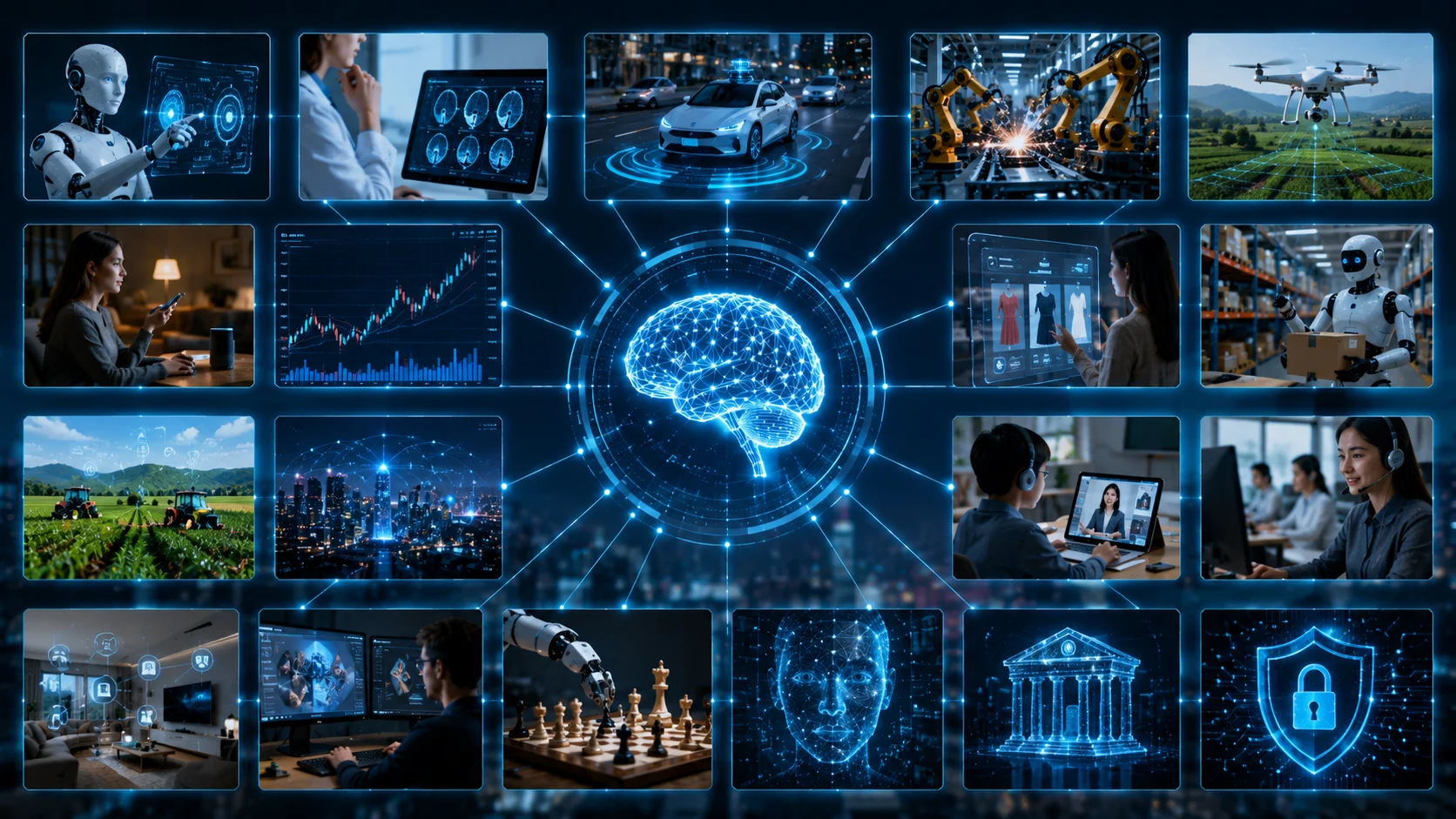
15 Applications of AI You Should Know About
Artificial intelligence has moved far beyond experimental chatbots and futuristic demonstrations. Today, AI applications are used across customer service, healthcare, finance, cybersecurity, manufacturing, transportation, education, retail, agriculture, software development, and many other industries. Businesses rely on machine learning to identify patterns, generative AI to create and transform information, computer vision to interpret images, and predictive analytics to estimate what may happen next. AI agents are also beginning to complete multi-step tasks across connected software tools. These technologies are changing how organizations operate, make decisions, serve customers, and develop products. Understanding the most important applications of AI can help businesses, professionals, and consumers see where artificial intelligence is already creating practical value rather than treating it as a single all-purpose technology.
The most useful AI applications usually solve clearly defined problems rather than attempting to automate everything. A retailer might use AI to forecast product demand, while a hospital may apply machine learning to medical imaging or administrative documentation. Banks use artificial intelligence to detect suspicious transactions, and manufacturers use computer vision to inspect products for defects. Software developers increasingly work with AI coding assistants, while marketers use generative tools for research and campaign development. These examples demonstrate why terms such as machine learning applications, AI automation, generative AI, predictive analytics, computer vision, natural language processing, intelligent automation, and AI-powered tools appear across many industries. The following 15 applications show how artificial intelligence is being used in practical, real-world settings.
1–3. AI in Customer Service, Marketing, and Sales
One of the most widespread applications of AI is customer service automation. Businesses receive large volumes of questions through websites, email, messaging applications, social platforms, and telephone systems, making it difficult for employees to answer every request immediately. AI chatbots can handle common questions about orders, appointments, returns, account information, product availability, and basic troubleshooting. More advanced systems can search company knowledge bases and generate responses based on approved business information. Customer service representatives can also use AI copilots that summarize previous interactions or suggest useful answers during conversations. These systems can reduce response times and help employees manage larger workloads. The strongest implementations still provide a clear route to human support when an automated system cannot resolve an issue confidently.
The second major application is AI-powered marketing. Marketing teams use artificial intelligence to analyze customer behavior, segment audiences, develop campaign ideas, personalize messaging, and measure performance. Generative AI can assist with initial drafts of emails, advertisements, landing pages, product descriptions, and social media content. Predictive models can estimate which customers may respond to particular offers, while recommendation engines can personalize content according to individual interests. AI can also analyze large collections of reviews, surveys, and online conversations to identify common opinions or customer frustrations. These capabilities allow marketers to make decisions using more information than they could reasonably review manually. However, effective marketing still requires human creativity, brand understanding, customer empathy, and strategic judgment because automatically generated content can quickly become generic.
The third important application is AI in sales. Sales representatives frequently spend substantial time researching prospects, updating CRM records, preparing follow-up messages, taking meeting notes, and deciding which opportunities deserve attention first. Artificial intelligence can automate or accelerate many of these administrative activities. AI systems can summarize sales calls, identify action items, prepare account briefs, draft personalized outreach, and recommend follow-up steps based on previous interactions. Predictive lead-scoring models can also help teams identify potential customers who appear more likely to purchase. These capabilities allow sales professionals to spend more time speaking with prospects and understanding their needs. AI should support rather than replace relationship-building because complex sales decisions often depend on trust, negotiation, industry expertise, and the ability to understand circumstances that structured data may not capture.
Customer service, marketing, and sales become even more powerful when AI connects information across all three functions. A customer service interaction might reveal that buyers frequently struggle with a particular feature, giving marketers useful material for educational content and providing sales teams with insight into common objections. AI can categorize thousands of conversations to surface these patterns automatically. Customer relationship management systems increasingly use machine learning and generative AI to create unified summaries of accounts across multiple touchpoints. This reduces the need for employees to search through disconnected records before understanding a customer’s history. Businesses can use these insights to provide more relevant communication at each stage of the customer journey. However, companies must manage customer information responsibly because personalization becomes harmful when people feel that their data is being used unexpectedly or intrusively.
These three applications demonstrate an important principle behind successful business AI: automation works best when it improves the experience for both customers and employees. A chatbot that prevents customers from reaching a real person can reduce operating costs while damaging satisfaction. An AI marketing system that produces hundreds of generic advertisements may increase output without improving conversions. Similarly, automated sales outreach can become counterproductive when messages feel inaccurate or impersonal. Businesses should therefore measure outcomes such as customer satisfaction, conversion rates, response times, retention, and revenue rather than simply counting how many tasks AI performs. Artificial intelligence provides the greatest value when it removes unnecessary friction while preserving human judgment where relationships matter. This balance will remain central as customer-facing AI systems become increasingly capable.
4–6. AI in Healthcare, Finance, and Cybersecurity
The fourth major application of artificial intelligence is AI in healthcare. Healthcare organizations use machine learning, natural language processing, and computer vision across medical imaging, administrative documentation, patient communication, scheduling, research, and operational planning. AI systems can help analyze medical images and highlight areas that may deserve closer attention from qualified clinicians. Generative tools can assist with summarizing medical notes or reducing time spent on routine documentation. Hospitals can also use predictive analytics to estimate staffing requirements, patient demand, or operational pressures. These applications can improve efficiency when deployed carefully. However, healthcare AI requires particularly strong standards for privacy, accuracy, validation, and human oversight because mistakes can affect patient safety. Artificial intelligence should generally support clinical professionals rather than replace responsible medical judgment.
The fifth application is AI in financial services. Banks, payment processors, insurers, investment firms, and other financial organizations manage enormous amounts of structured and unstructured data. Machine learning can detect unusual transaction patterns and flag potentially fraudulent activity for investigation. AI can also automate document processing, analyze customer requests, support credit-related workflows, summarize financial information, and assist with compliance tasks. Predictive analytics helps institutions estimate risk and evaluate different financial scenarios. Generative AI increasingly supports internal knowledge retrieval by helping employees search policies, reports, and large document collections using natural-language questions. Because financial decisions can have serious consequences, organizations need strong controls around automated approvals and recommendations. Human specialists remain responsible for validating important outcomes and ensuring systems comply with applicable financial requirements.
Fraud detection illustrates why AI can outperform simple rule-based systems in certain financial situations. Traditional fraud systems might flag every transaction exceeding a fixed amount or occurring in an unusual location. Machine learning can consider many signals simultaneously, including purchasing behavior, device information, transaction timing, location patterns, and relationships among accounts. This can help identify suspicious activity that does not match one obvious rule. Models can also adapt as fraud strategies evolve, although criminals may use artificial intelligence to develop more sophisticated attacks themselves. Financial institutions therefore continually update detection systems rather than deploying a model once and assuming it will remain effective indefinitely. AI works best as part of a broader fraud-prevention system combining automated detection, identity verification, cybersecurity, investigations, and experienced human decision-making.
The sixth application is AI in cybersecurity. Modern organizations generate enormous quantities of security data from networks, applications, devices, user accounts, and cloud environments. Security analysts cannot manually inspect every event, so AI systems can help identify unusual activity and prioritize alerts that may indicate a genuine threat. Machine learning can analyze patterns associated with malware, account compromise, phishing, or abnormal network behavior. Generative AI can assist analysts by summarizing alerts, explaining technical information, or drafting investigation steps. Security teams can also use AI to review code for possible vulnerabilities. At the same time, attackers can use generative tools to create convincing phishing messages or accelerate malicious activity. This makes AI both a defensive capability and a technology that security professionals must protect against.
Healthcare, finance, and cybersecurity highlight the importance of human oversight when artificial intelligence operates in high-stakes environments. A marketing draft containing awkward wording may be inconvenient, but an incorrect medical recommendation, financial decision, or security response can cause much greater harm. Organizations should therefore match the level of AI autonomy to the consequences of potential errors. Low-risk tasks such as summarization may require basic review, while important decisions may need qualified approval before action occurs. Audit logs, access controls, validation procedures, and clear accountability are also essential. AI can increase the speed at which professionals process information, but faster decision-making should not come at the expense of reliability. The best high-stakes applications combine machine efficiency with human responsibility rather than attempting to remove professionals completely from the process.
7–9. AI in Manufacturing, Supply Chains, and Transportation
The seventh major application is AI in manufacturing. Modern factories use sensors, cameras, industrial software, and connected machinery that generate information continuously. Machine learning can analyze this data to identify equipment performance changes and predict when maintenance may be required. Predictive maintenance allows manufacturers to repair machinery before unexpected failures interrupt production. Computer vision can inspect products for defects such as incorrect dimensions, damaged surfaces, missing components, or assembly problems. AI can also help optimize production schedules according to demand, resource availability, equipment capacity, and delivery requirements. These capabilities improve efficiency because manufacturing involves thousands of repeated activities where even small improvements can produce substantial savings. Human engineers remain essential because machines still require expert supervision, maintenance, safety planning, and process design.
The eighth application is AI in supply-chain management. Businesses need to decide how much inventory to purchase, where products should be stored, which suppliers should receive orders, and how goods should move between locations. These decisions become increasingly difficult when demand changes quickly or supply disruptions occur unexpectedly. Predictive analytics can examine historical sales, seasonal patterns, promotions, economic conditions, and other signals to improve demand forecasting. AI can also identify potential inventory shortages and recommend alternative sourcing options. Logistics planners may use machine learning to optimize warehouse operations and delivery networks. The objective is not simply to reduce inventory as much as possible because insufficient stock creates lost sales and disappointed customers. Successful AI supply-chain systems balance cost, availability, speed, resilience, and changing customer demand.
The ninth application is AI in transportation and logistics. Delivery companies can use artificial intelligence to optimize routes according to traffic, fuel usage, vehicle capacity, delivery windows, and changing conditions. Airlines apply analytics to scheduling, maintenance, and operational planning, while shipping companies use AI to manage complex networks involving ports, warehouses, and distribution centers. Autonomous driving technologies also rely heavily on machine learning, computer vision, radar processing, mapping, and decision systems. Fully autonomous transportation remains a difficult technical and regulatory challenge in many environments, but specialized autonomy already appears in warehouses, industrial sites, and controlled routes. AI can also support human drivers through advanced assistance systems. Transportation applications show how artificial intelligence can connect digital decision-making directly with physical movement, making reliability and safety particularly important.
Digital twins are increasingly connecting manufacturing, logistics, and transportation AI. A digital twin is a virtual representation of a physical asset, facility, or process that can be updated using real operational data. Companies can use these models to simulate changes before modifying expensive physical systems. A manufacturer might test a new production layout virtually, while a logistics company could model how warehouse changes affect throughput. AI can analyze simulation results and identify configurations that appear more efficient. Engineers can then decide whether those recommendations make practical sense before implementing them in the real environment. This approach reduces some of the cost and risk associated with experimentation. Digital twins become particularly valuable when physical assets are expensive, dangerous, or difficult to stop for testing.
These industries also demonstrate the growing importance of edge AI. Sending every camera frame or sensor reading to a distant cloud server can create unnecessary delays and bandwidth costs. Edge computing allows some artificial intelligence processing to happen directly on equipment, vehicles, cameras, or nearby computing devices. A factory camera can identify a product defect immediately, while an autonomous machine can respond to an obstacle without waiting for instructions from a remote data center. Local processing can also improve privacy because some information never needs to leave the physical location. More complicated analysis can still be sent to cloud systems when necessary. This combination of local and cloud AI is likely to become increasingly common as intelligent computing spreads from software applications into factories, transportation systems, robots, and other connected environments.
10–12. AI in Education, Human Resources, and Software Development
The tenth application is AI in education. Students can use artificial intelligence for personalized explanations, practice questions, language support, feedback, and tutoring-style interactions. Teachers may use AI to prepare lesson ideas, create differentiated exercises, summarize learning materials, or organize administrative work. Adaptive learning platforms can adjust difficulty according to a student’s performance, providing additional practice when particular concepts remain challenging. These capabilities can make educational support more accessible, especially when teachers have limited time to provide individual instruction to every learner. However, AI-generated answers can contain mistakes, and students may rely too heavily on tools instead of developing their own reasoning skills. Effective educational use therefore requires guidance about verification, academic integrity, and when students should solve problems independently before requesting assistance.
Artificial intelligence can also support teachers by reducing time spent on repetitive administrative tasks. Educators frequently prepare worksheets, format instructional materials, summarize student progress, draft communications, and organize lesson plans. Generative AI can create initial versions of these materials that teachers refine according to their students’ needs. Language models can also help translate content or adjust explanations for different reading levels. This does not remove the importance of professional educators because teaching depends heavily on motivation, relationships, classroom management, emotional understanding, and knowledge of individual students. AI cannot automatically determine whether a learner is struggling because of a difficult concept, personal circumstances, lack of confidence, or another issue. Technology works best when it gives teachers additional time to focus on the human parts of education.
The eleventh application is AI in human resources. HR departments can use artificial intelligence to summarize employee feedback, organize job descriptions, answer routine policy questions, assist with workforce planning, and automate administrative processes. Recruiting teams may use AI to organize applications or support candidate communications, although automated hiring decisions require careful attention to fairness and transparency. Machine learning can potentially identify workforce trends involving retention, skills requirements, or staffing needs. Employees can also use internal AI assistants to search benefits information, workplace policies, and training resources. HR data is highly sensitive, making privacy and access controls particularly important. Businesses should avoid assuming that algorithmic recommendations are automatically objective because historical employment data can contain biases that models may reproduce if systems are not evaluated carefully.
The twelfth major application is AI in software development. Coding assistants can generate functions, explain unfamiliar code, suggest tests, identify possible bugs, document programs, and help developers work across unfamiliar programming languages. More advanced AI agents can perform defined engineering tasks across multiple files, such as implementing a feature or updating sections of a codebase. These tools can substantially accelerate repetitive programming activities, especially when developers already understand the architecture and can evaluate generated changes. AI is also useful for explaining error messages and suggesting possible troubleshooting steps. However, generated code can contain security weaknesses, incorrect assumptions, or subtle bugs. Developers remain responsible for reviewing, testing, and maintaining software. AI makes programming faster, but speed becomes valuable only when teams preserve reliability and security.
Education, human resources, and software development demonstrate how AI can operate as a copilot rather than a replacement. A teacher can use AI to prepare materials while remaining responsible for instruction. An HR professional can automate policy questions while personally managing sensitive employee situations. A software developer can generate code faster while applying engineering judgment during review. This pattern is likely to remain common because many professional roles contain a mixture of predictable tasks and complicated situations requiring context. Organizations can gain productivity by assigning repetitive information-processing work to AI while keeping people responsible for decisions that involve ethics, relationships, strategy, or safety. The most effective systems are therefore designed around collaboration between humans and machines rather than assuming every task should eventually become fully automated.
13–15. AI in Retail, Agriculture, and Content Creation
The thirteenth application is AI in retail and ecommerce. Online stores use recommendation engines to help shoppers discover products based on browsing behavior, purchases, preferences, and similarities with other customers. Retailers also apply predictive analytics to demand forecasting, inventory management, pricing, and promotions. Computer vision can help monitor shelves or support automated checkout systems in certain environments. Customer service AI answers questions about products, shipping, returns, and order status. Generative AI can create product description drafts or help shoppers compare options through conversational interfaces. These capabilities can improve convenience while helping retailers understand customer behavior at greater scale. However, personalization should remain useful rather than intrusive, and companies must manage consumer information responsibly when building recommendation or targeting systems.
The fourteenth application is AI in agriculture. Farmers increasingly use sensors, drones, satellite imagery, weather data, and computer vision to understand crop and soil conditions. Machine learning can analyze this information to identify disease, estimate yields, detect irrigation problems, or recommend where resources may be needed most. Precision agriculture attempts to apply water, fertilizer, or crop protection more selectively instead of treating every part of a field identically. This can improve efficiency while potentially reducing unnecessary resource use. AI-powered equipment and agricultural robots may also automate activities such as weeding, monitoring, or harvesting in appropriate crops. Agricultural decisions remain heavily influenced by unpredictable conditions such as weather, pests, and soil variation. AI provides additional information, but experienced farmers still need to interpret recommendations according to local realities.
Computer vision is especially useful in agriculture because many farming decisions depend on visual information. Cameras mounted on drones, tractors, or fixed equipment can capture large numbers of crop images that would take people enormous amounts of time to inspect manually. AI models can identify patterns associated with plant stress, weeds, pests, or uneven growth. Farmers can then focus physical inspections on locations where potential problems appear. Similar systems may help sort agricultural products after harvesting according to size, quality, or visible defects. These technologies can make large farming operations easier to monitor while providing more detailed information about individual sections of a field. Accuracy still depends on training data and environmental conditions because a model developed for one crop or region may not perform equally well somewhere else.
The fifteenth application is AI in content creation and media. Generative AI can produce text, images, audio, video, music-like compositions, presentations, and other digital materials from natural-language instructions. Writers use AI for research organization and drafting, while designers can rapidly explore visual concepts. Video teams may use artificial intelligence for transcription, captioning, translation, editing assistance, or generating early creative ideas. Media companies can also analyze enormous archives to locate relevant clips or organize content automatically. These capabilities significantly reduce the time between an initial idea and a usable prototype. However, faster generation creates new concerns around originality, misinformation, copyright, attribution, and the possibility of flooding audiences with low-quality material. Human creative judgment becomes more important when production itself becomes inexpensive.
Retail, agriculture, and creative industries illustrate how broadly artificial intelligence can adapt to different kinds of problems. Retail AI focuses heavily on customer behavior and operational efficiency, agricultural AI combines digital analysis with physical environments, while creative AI transforms the way people produce and edit information. These areas appear unrelated on the surface, yet they rely on similar underlying technologies such as machine learning, computer vision, predictive analytics, and generative models. The difference lies in the data, workflows, and outcomes each industry requires. This is why businesses rarely benefit from adopting “AI” as a vague strategy. They need to identify which specific capability fits the problem they are trying to solve. Successful artificial intelligence applications are usually specialized combinations of models, data, software, and human expertise rather than one universal technology.
Major Benefits and Challenges of AI Applications
Efficiency is one of the strongest benefits shared across nearly every application of artificial intelligence. AI can process large quantities of information much faster than people can review manually, making it valuable for repetitive analysis and high-volume workflows. A fraud system can examine millions of transactions, while a manufacturing model can monitor sensor information continuously. Customer service assistants can respond to routine questions at any hour, and coding tools can automate repetitive programming steps. These capabilities can reduce operating costs and free employees to focus on activities requiring deeper judgment. The productivity gain depends on implementation quality, however. Automating an inefficient process without redesigning it may simply produce poor results faster. Businesses should therefore examine the entire workflow instead of assuming that adding AI automatically improves efficiency.
Better decision support is another important benefit. Predictive analytics can reveal patterns that help businesses estimate demand, customer behavior, operational risk, or equipment performance. AI systems can also summarize documents and datasets that managers might otherwise struggle to review completely. Faster access to relevant information can improve the quality and speed of decisions. However, AI recommendations should remain inputs rather than unquestionable commands. Historical data may not represent unusual future conditions, and algorithms can miss factors that experienced professionals recognize immediately. Organizations should develop processes for evaluating uncertainty and challenging automated recommendations when necessary. The best decision-support systems make human expertise more informed rather than attempting to remove people entirely from important decisions. Artificial intelligence can expand what people know while humans remain responsible for interpreting what that information means.
Accuracy remains a major challenge because AI systems can make mistakes in ways that are difficult to predict. Generative models may produce plausible but incorrect statements, computer vision systems can misidentify unfamiliar objects, and predictive models can fail when real conditions differ from training data. The consequences vary according to the use case. An incorrect product description may be easily fixed, while an error affecting healthcare, financial services, transportation, or cybersecurity could be much more serious. Businesses therefore need different levels of testing and oversight according to risk. High-stakes applications should have stronger validation, audit trails, and human approval. Organizations should also measure real-world performance after deployment rather than relying only on development tests. AI applications require ongoing monitoring because models, users, business conditions, and available data all change over time.
Privacy and security create another major challenge as AI systems gain access to increasingly sensitive information. Employees may accidentally upload confidential company data into tools that are not approved for business use. AI agents connected with internal software could potentially access customer records, financial systems, or private documents if permissions are configured poorly. Organizations need clear policies explaining which tools employees may use and what information can be entered into them. Access controls should follow the same principle used elsewhere in cybersecurity: systems should receive only the permissions necessary to perform their tasks. Businesses should also understand how vendors store and process uploaded information. Strong security does not prevent innovation; it gives organizations enough confidence to expand AI use without creating unnecessary exposure.
Bias, accountability, and employee adaptation present additional challenges that technology alone cannot solve. Machine learning models can reproduce patterns contained in historical data, including unfair outcomes that organizations may not want to continue. Automated systems used in areas such as hiring, lending, insurance, or pricing therefore require careful evaluation. Employees may also need training as job responsibilities change around AI tools. Some people may distrust useful systems, while others may overtrust generated recommendations. Clear policies, practical education, and defined responsibility can reduce both problems. Businesses should identify who is accountable for decisions made with AI assistance. A model cannot accept professional or legal responsibility for a consequential outcome. Successful adoption therefore depends on governance, culture, and human leadership alongside technical capability.
How to Choose the Right AI Applications
The best way to choose an AI application is to begin with a business problem rather than a technology. Organizations should identify where customers experience frustration, where employees spend unnecessary time, where errors repeatedly occur, or where better predictions could improve outcomes. A company might discover that service representatives spend several hours each day answering the same basic questions. Another business may lose revenue because inventory forecasting is inaccurate. These clearly defined problems provide a much stronger starting point than simply asking how the company can “use AI.” Teams can then determine whether artificial intelligence is actually appropriate for solving the issue. Sometimes conventional software automation or a process change will provide a cheaper and more reliable solution than implementing machine learning.
The potential value of each use case should be estimated before significant investment begins. Businesses can calculate how much employee time the current process requires, how frequently errors occur, what delays cost customers, or how improvements might influence revenue. These estimates do not need to be perfectly precise to help compare opportunities. An AI project capable of saving thousands of employee hours may deserve more attention than one that creates minor convenience for a small number of users. Risk should also be considered alongside potential value. Automating low-risk document classification is very different from allowing a model to approve financial transactions autonomously. Organizations can prioritize projects that offer substantial benefits while keeping potential consequences manageable. This makes early AI adoption more likely to demonstrate positive results.
Data readiness is another important selection factor. Predictive models require useful historical information, while generative assistants often need access to reliable business knowledge. If company records are incomplete, inconsistent, outdated, or difficult to access, AI performance may disappoint regardless of how advanced the model appears. Organizations should therefore identify what information each application requires and assess whether that information is trustworthy enough for automated use. They should also confirm that appropriate privacy permissions exist. Improving data quality can sometimes deliver value even before artificial intelligence is deployed because cleaner information benefits analytics and ordinary software systems as well. Companies should view data management as part of AI implementation rather than a separate technical issue that can be addressed later.
Pilot projects provide a practical way to test whether a proposed AI application works under real conditions. A company can choose one department, customer group, workflow, or location instead of deploying technology across the entire organization immediately. Employees who understand the process should participate because they can identify unusual situations that developers may overlook. The pilot should measure specific outcomes such as time saved, accuracy, customer satisfaction, error rates, revenue, or cost per transaction. Negative results can be useful because they reveal whether the technology, data, or workflow requires improvement before further investment. Successful pilots provide evidence supporting expansion. This incremental strategy allows businesses to learn from actual usage rather than committing heavily based on demonstrations that may not represent everyday operational conditions.
Long-term maintenance should also influence technology selection. AI applications require monitoring, updates, security reviews, data management, employee training, and sometimes additional computing costs. Businesses should understand whether they have the expertise to manage these requirements internally or whether a vendor will provide ongoing support. Vendor lock-in can become a concern when important workflows depend heavily on one proprietary platform. Organizations may also want flexibility to switch models as technology improves. Total cost of ownership should therefore include more than the initial subscription or implementation fee. A cheaper AI tool can become expensive if it requires extensive manual correction, while a more expensive system may create better economics if it operates reliably. The right application balances performance, cost, security, usability, scalability, and long-term maintainability.
The Future of AI Applications
AI agents are likely to become one of the most important developments shaping future applications. Traditional AI assistants mostly respond to individual prompts, while agents can pursue an objective through several connected steps. A business agent might gather information, update records, prepare a report, send an approved message, and schedule a follow-up task within one workflow. This could reduce the amount of time employees spend moving information manually between applications. However, greater autonomy increases the importance of permissions, monitoring, and approval controls. An agent capable of performing useful actions can also create larger problems when it makes a mistake. Organizations will therefore need to decide carefully which activities can be fully automated and which require human confirmation. Controlled autonomy is likely to become more common before unrestricted agents become practical.
Multimodal AI will also expand the range of information artificial systems can work with. Instead of processing only text, a single model may interpret documents, images, voice, video, charts, and structured business data together. A technician could photograph a damaged machine, describe the symptoms verbally, and receive troubleshooting suggestions based on both inputs. A retailer might analyze product images alongside customer reviews and sales records. Educational systems could combine written explanations with diagrams and spoken tutoring. These capabilities make AI interaction more natural because real-world problems rarely exist in one data format. Businesses will still need specialized systems for high-precision tasks, but multimodal models can become useful interfaces connecting different forms of information. This may gradually change how people interact with workplace software altogether.
Smaller and specialized AI models are likely to grow alongside enormous general-purpose systems. Organizations increasingly recognize that the largest available model is unnecessary for every task. A compact model can classify documents, summarize routine information, or operate on a local device at lower cost. Industry-specific models may also perform better when they understand specialized terminology and workflows. Businesses could therefore use a combination of systems, routing simple requests to inexpensive models and difficult reasoning tasks to more powerful services. This approach can improve performance while controlling computing expenses. Edge AI will further expand these possibilities by allowing models to run directly on vehicles, equipment, smartphones, cameras, and industrial devices. Artificial intelligence may increasingly become an invisible capability embedded throughout products rather than a separate application users deliberately open.
Physical AI and robotics represent another major long-term opportunity. Artificial intelligence is gradually giving robots stronger perception, language understanding, planning, and adaptive control. Manufacturing and warehouses already use specialized robotic systems, while future machines may handle increasingly varied tasks. Agriculture, logistics, construction, healthcare support, and household environments could eventually benefit from more capable robotics. Progress will likely be gradual because interacting safely with the physical world is substantially harder than generating digital information. Robots must deal with unpredictable objects, people, lighting, weather, and mechanical failures. Reliability matters more when software controls a physical machine that can cause damage. Even so, the combination of AI, sensors, simulation, and better hardware could make intelligent robotics one of the most transformative applications of artificial intelligence over the coming decade.
The broader future of artificial intelligence will probably involve AI becoming less visible as a separate technology category. Today, companies frequently advertise products specifically as “AI-powered,” but users may eventually expect intelligent capabilities inside ordinary software, devices, vehicles, and services. Email applications will summarize information, accounting systems will identify unusual transactions, factories will monitor equipment automatically, and customer platforms will recommend next actions without users thinking about the underlying technology. The most successful applications may therefore be those where artificial intelligence quietly removes friction rather than constantly reminding users that they are interacting with AI. Human oversight will remain necessary wherever judgment, responsibility, creativity, or relationships matter. The long-term value of artificial intelligence will come from how effectively it improves real outcomes rather than how impressive the technology appears in isolation.
Frequently Asked Questions
What are the most common applications of AI?
Common AI applications include customer service, marketing, sales, healthcare, finance, cybersecurity, manufacturing, supply-chain management, transportation, education, human resources, software development, retail, agriculture, and content creation. Different industries use combinations of machine learning, computer vision, generative AI, natural language processing, and predictive analytics.
How is AI used in everyday life?
AI appears in recommendation systems, navigation applications, spam filtering, voice assistants, search engines, personalized advertisements, fraud detection, smartphone photography, and customer service chatbots. Many people interact with artificial intelligence every day without actively realizing that AI is operating behind the service.
What is the biggest benefit of artificial intelligence?
One of the biggest benefits is the ability to process large quantities of information quickly and automate repetitive work. This can improve productivity, reduce costs, support better decisions, and allow employees to spend more time on activities requiring human judgment.
Which industries use AI the most?
Technology, financial services, retail, healthcare, manufacturing, transportation, media, ecommerce, and professional services are among the industries using AI extensively. Adoption is also increasing rapidly in agriculture, education, logistics, government, construction, and other specialized sectors.
Will AI applications replace human workers?
AI is more likely to automate specific tasks and reshape job responsibilities than eliminate every activity within most professions. Human judgment, accountability, communication, creativity, leadership, and relationship-building remain important even as artificial intelligence handles more repetitive information-processing work.