

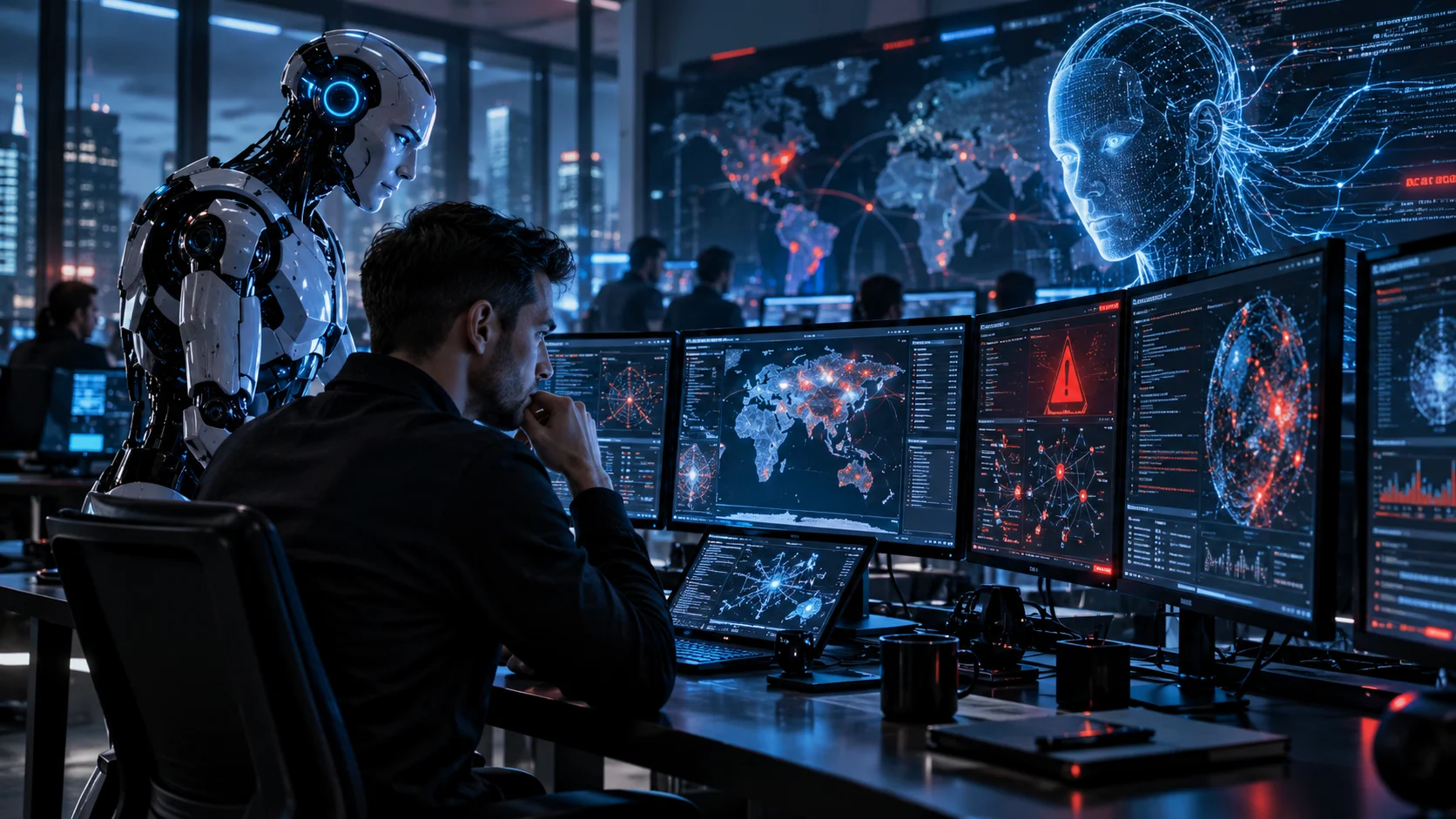
Artificial intelligence is changing how organizations detect threats, analyze security data, automate investigations, and respond to suspicious activity. As AI tools become more capable, many professionals and students are asking, will AI take over cyber security and eventually replace human security teams? The answer is more complex than a simple yes or no.
AI can already process enormous volumes of security information faster than humans, recognize unusual patterns, prioritize alerts, and automate repetitive tasks. However, cyber security involves judgment, strategy, investigation, communication, and decision-making that cannot always be reduced to automation. Human expertise remains essential when threats are unfamiliar, ambiguous, or connected to wider business risks.
Rather than completely replacing cyber security professionals, AI is more likely to transform how they work. Security teams will increasingly use artificial intelligence as an assistant that helps them investigate incidents faster and focus on difficult problems. Understanding this relationship is important for anyone considering a future career in cyber security.
How AI Is Already Changing Cyber Security
AI is already being integrated into many modern cyber security platforms. Security tools use machine learning to analyze network activity, user behavior, device events, malware characteristics, and authentication patterns. Instead of relying entirely on predefined rules, AI-assisted systems can identify unusual behavior that might indicate a developing security threat.
This capability is particularly useful because organizations generate huge amounts of security data every day. Human analysts cannot manually examine every login, connection, file change, or application event. AI can filter this information, highlight suspicious activity, and help analysts decide which alerts deserve immediate investigation.
Automation also reduces repetitive manual work. Security teams can use AI-assisted platforms to summarize incidents, categorize alerts, investigate common patterns, and suggest possible next steps. This does not remove humans from the process, but it can allow experienced professionals to spend more time on complex analysis, threat hunting, and strategic security improvements.
Will AI Take Over Cyber Security Jobs?
AI is unlikely to eliminate every cyber security job because security involves much more than processing information. Professionals must understand business systems, evaluate risk, communicate with stakeholders, investigate unexpected behavior, and make decisions when available evidence is incomplete. These responsibilities often require context and judgment that automated systems may not fully understand.
Some repetitive tasks are more likely to become automated. Entry-level analysts may spend less time manually reviewing basic alerts, searching logs, or preparing routine reports as AI tools improve. However, professionals will still need to validate findings, investigate unusual cases, configure security systems, and determine whether automated recommendations are appropriate.
Therefore, asking will AI take over cyber security may be less useful than asking how AI will change cyber security roles. Professionals who understand security fundamentals and know how to work effectively with AI tools may become more productive. The job will evolve, but the need for skilled security decision-makers is unlikely to disappear.
Which Cyber Security Tasks Can AI Automate?
Alert triage is one of the most obvious areas for automation. Security operations centers may receive thousands of alerts from endpoints, networks, cloud environments, and identity systems. AI can analyze these signals, group related events, remove obvious duplicates, and prioritize incidents based on potential risk.
AI can also assist with malware analysis, phishing detection, vulnerability prioritization, and threat intelligence. Machine learning systems can compare suspicious files or messages against large collections of previous examples. They may identify patterns much faster than an analyst manually reviewing every individual case, especially when dealing with high volumes of data.
Routine reporting and investigation summaries can also become more automated. AI tools can organize incident timelines, summarize relevant logs, and provide analysts with useful context before they begin deeper investigation. Human professionals still need to confirm whether the automated interpretation is accurate and decide what actions should actually be taken.
Why Human Cyber Security Experts Will Still Matter
Attackers constantly develop new techniques designed to bypass existing defenses. Automated systems generally perform best when they can learn from known behaviors, historical examples, or recognizable patterns. Completely new attacks may require human investigators who can think creatively, connect unrelated evidence, and understand why unusual activity matters.
Cyber security decisions also involve business context. A suspicious login on one account may be insignificant, while similar activity involving an administrator or financial system could represent a serious incident. Human analysts understand organizational priorities, sensitive systems, regulatory requirements, and operational consequences that may not be obvious from technical data alone.
Communication is another area where professionals remain essential. During a major incident, security teams may need to explain technical findings to executives, developers, employees, legal teams, or customers. Communicating uncertainty, recommending practical actions, and balancing security with business needs requires judgment that extends beyond automated threat detection.
Can AI Make Cyber Security More Effective?
AI can make cyber security more effective when it is used to support skilled professionals rather than replace them entirely. Automated analysis can process data quickly and surface suspicious activity that might otherwise be missed. Analysts can then focus their attention on the events most likely to represent meaningful threats.
Artificial intelligence can also help security teams respond more quickly. When systems automatically collect relevant information, classify incidents, and suggest response steps, analysts spend less time gathering basic context. Faster investigations can reduce the amount of time attackers remain undetected inside networks and give defenders a better opportunity to contain potential damage.
However, effectiveness depends on implementation quality. Poorly configured AI systems can generate misleading recommendations, overlook important threats, or create unnecessary alerts. Organizations still need experienced professionals to configure tools, monitor performance, verify decisions, and ensure automated systems are aligned with real security requirements.
How Attackers Are Using AI Too
AI is not available only to defenders. Attackers can also use generative AI and automation to create more convincing phishing messages, research potential targets, write malicious scripts, and accelerate repetitive parts of cyber attacks. This creates an ongoing competition between offensive and defensive uses of emerging technology.
Social engineering may become especially challenging because AI can generate natural-looking messages quickly and at scale. Attackers can customize emails, messages, or other communication for different audiences without spending as much time writing each one manually. Security awareness training and identity verification therefore remain important even when technical security tools improve.
At the same time, AI does not automatically turn inexperienced attackers into advanced cyber criminals. Successful attacks still require understanding of systems, vulnerabilities, access controls, and operational security. Just as defenders need cyber security knowledge to use AI effectively, attackers also need technical understanding to turn automated suggestions into successful real-world operations.
Will Entry-Level Cyber Security Roles Disappear?
Entry-level roles may change significantly as organizations automate repetitive monitoring and administrative tasks. Traditional security analysts sometimes begin by reviewing alerts, checking logs, and escalating suspicious activity. AI can perform parts of these tasks faster, which may reduce the amount of purely repetitive work assigned to junior employees.
However, entry-level professionals will still be needed to investigate cases, understand security systems, support incident response, manage access, review vulnerabilities, and learn organizational environments. The difference is that employers may increasingly expect junior employees to work alongside automated tools rather than perform every process manually.
This shift makes strong fundamentals even more valuable. Beginners should understand networking, operating systems, authentication, cloud platforms, and security principles rather than relying entirely on tools. Anyone concerned about cyber security difficulty should focus on building these foundations because they remain useful regardless of how much automation improves.
What Cyber Security Skills Will Become More Valuable?
Critical thinking will become increasingly important as AI handles more routine analysis. Security professionals must determine whether automated conclusions make sense, recognize missing context, and investigate situations where the system may be wrong. Knowing how to challenge an AI-generated recommendation can be just as important as knowing how to use the tool.
Threat hunting and incident investigation are also likely to remain valuable skills. These activities require professionals to develop hypotheses, explore unusual patterns, combine information from different sources, and understand attacker behavior. AI can assist with data collection and analysis, but skilled investigators still need to interpret what the evidence means.
Communication, risk assessment, cloud security, identity management, and security architecture should remain important as well. Organizations need professionals who can design secure systems and explain technical risks in business terms. Cyber security workers who combine technical knowledge with decision-making abilities will be better prepared for an AI-supported environment.
Should Cyber Security Students Learn AI?
Students entering cyber security should understand how AI tools work, where they are useful, and where they can make mistakes. You do not necessarily need advanced machine learning knowledge before beginning a security career. However, becoming comfortable with AI-assisted investigation, automation, prompting, and data analysis can make you more effective.
Learning should still begin with core technical foundations. Networking, Linux, Windows, security principles, cloud fundamentals, and basic scripting are more important than simply learning how to ask an AI tool questions. Without foundational knowledge, it becomes difficult to determine whether an AI-generated security explanation or recommendation is accurate.
A strong approach is to treat AI as another tool in your security toolkit. Use it to explain unfamiliar concepts, summarize information, organize investigations, or help automate repetitive tasks while independently verifying important results. Students who combine AI literacy with real cyber security knowledge may be better prepared for modern security roles.
What Are the Risks of Using AI in Cyber Security?
One major risk is overconfidence in automated decisions. AI systems can produce incorrect conclusions, miss important context, or generate responses that sound convincing despite being inaccurate. If security teams trust every output without verification, automation can create new weaknesses instead of reducing existing risks.
Privacy and sensitive data handling are also important concerns. Security professionals frequently work with logs, employee information, internal systems, and incident details that may be confidential. Organizations need clear rules governing which information can be processed by external AI services and how sensitive security data should be protected.
Attackers may also attempt to manipulate AI-powered security systems. Adversarial techniques could be designed to hide malicious behavior, influence automated classifications, or exploit weaknesses in AI integrations. Therefore, AI systems themselves need security controls, monitoring, access restrictions, testing, and ongoing human oversight.
What Will the Future of AI and Cyber Security Look Like?
Future cyber security teams will likely rely on increasingly intelligent automation for monitoring, investigation, vulnerability management, and response. AI assistants may help analysts search logs, explain alerts, generate detection rules, summarize incidents, and coordinate response activities. This could allow smaller teams to manage larger and more complex technology environments.
The role of security professionals may gradually shift from performing repetitive tasks toward supervising automation and solving higher-level problems. Analysts may spend more time investigating unusual incidents, designing defenses, managing risks, validating automated decisions, and communicating with other teams. Technical knowledge will remain important because professionals must understand what automated systems are actually doing.
Cyber security careers will therefore evolve rather than simply disappear. People who continuously learn, understand security fundamentals, and adapt to new technology will be positioned to work alongside increasingly capable AI systems. The future is likely to involve collaboration between humans and artificial intelligence rather than complete replacement of human security expertise.
Conclusion
So, will AI take over cyber security? AI will certainly automate many repetitive activities, improve threat detection, accelerate investigations, and change how security teams operate. However, cyber security still depends heavily on human judgment, technical understanding, communication, creativity, and knowledge of business context.
Professionals should view AI as a productivity tool rather than simply a threat to their careers. Learning how to use AI responsibly while strengthening networking, operating systems, cloud security, scripting, and investigation skills can create a stronger professional foundation. Human expertise becomes more valuable when professionals know how to validate and guide automated systems.
The future of cyber security will likely combine intelligent machines with skilled human defenders. AI may perform more routine analysis, but people will continue making important decisions, investigating unfamiliar threats, and designing secure systems. Those who adapt their skills as technology evolves will remain an important part of modern cyber security teams.
FAQs
Will AI completely replace cyber security professionals?
AI is more likely to automate repetitive security tasks than replace entire teams. Human professionals will still be needed for investigations, strategic decisions, risk management, communication, and situations requiring business context.
Which cyber security jobs are most affected by AI?
Roles involving repetitive alert review, basic log analysis, and routine reporting may experience greater automation. However, these jobs are also likely to evolve toward investigation, validation, and management of AI-assisted security systems.
Should I still study cyber security because of AI?
Yes. Cyber security fundamentals remain important because organizations still need people who understand systems, threats, risks, and defenses. Learning to work effectively with AI can complement those technical skills.
Can AI detect cyber attacks automatically?
AI can identify suspicious patterns and help detect many potential attacks, but it is not perfect. Human analysts are still needed to verify alerts, understand context, and decide how serious an incident is.
What skills should cyber security professionals learn for the AI era?
Focus on networking, operating systems, cloud security, scripting, threat analysis, incident response, communication, and critical thinking. AI literacy and automation skills can further strengthen your ability to work with modern security technologies.